Twelve illustrated chapters connecting the people, places, and turning points of U.S. history to the wider world.
12 chapters · Complete print edition · Coverage through 2024
CHAPTER 01 / Before 1492–1607
Indigenous America and the Atlantic World
Explore the histories already unfolding in the Americas and the unequal connections that transformed life across the Atlantic.
Main text: about 5 minPeople & places / World context / Sources
For whom, and in what ways, was 1492 a turning point?
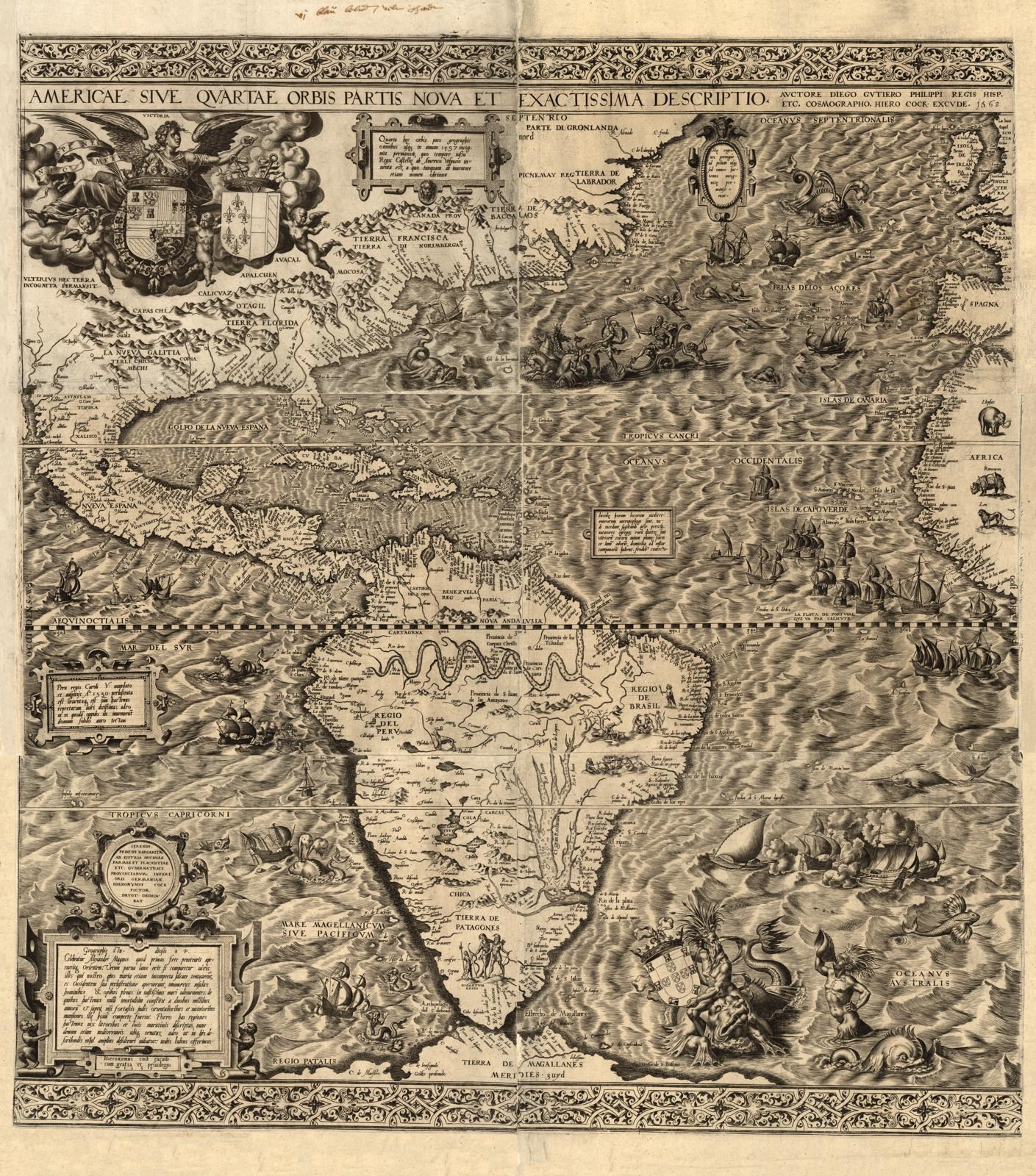
Americae sive qvartae orbis partis nova et exactissima descriptio · 1562 A European map of the Americas from the sixteenth century. Its coasts and place names record knowledge gained through voyages; the interior also reflects European imaginings. Maps could convey geographical information and ambitions for possession at the same time.Diego Gutierrez (cartographer); Hieronymus Cock (engraver and publisher) · Collection record and reuse information
A Continent with Its Own Histories
American history did not begin when Europeans arrived. Long before 1492, the Americas contained societies with distinct languages, institutions, and trading networks. Maya communities developed writing and sophisticated calendars. The Mexica, or Aztecs, built an empire centered on Tenochtitlan, while the Inka linked Andean regions through roads, terraces, and storehouses. These histories reach beyond present-day United States borders, but they are essential to understanding the hemisphere.
Within what became the United States, Cahokia grew into a major city in the Mississippi valley, with plazas and earthen platform mounds supporting ceremonial and public buildings. Across North America, Indigenous peoples combined agriculture, fishing, hunting, and trade in different ways. They shaped their environments and maintained political relationships with their neighbors. No single description can capture this diversity, and none should portray Indigenous peoples as merely waiting for Europeans.
Food, Land, and Political Life
Maize agriculture helped support large settlements, but farming did not produce a single political system. Some communities governed through kinship groups and village councils; others built states sustained by tribute and military power. The Haudenosaunee maintained a confederacy in which distinct nations addressed common concerns. Land use involved rights and obligations even where European-style deeds did not exist. Such territories were not ownerless.1
Modern borders can hide these connections. The Mississippi and its tributaries carried people and goods, while crops originating farther south transformed communities to the north. Harvest failures, migration, and political conflict altered relationships over time. Indigenous societies were neither isolated nor unchanging. Their later decisions about European goods, weapons, and alliances emerged from histories and priorities already their own.
1492 and the Columbian Exchange
In 1492, Christopher Columbus crossed the Atlantic under Castilian royal sponsorship while seeking a western route to Asia. He reached Caribbean islands inhabited by the Taíno. For their residents, these were homelands, not newly discovered places. His voyage mattered because it initiated sustained connections, colonization, and conquest across the Atlantic. His published account acknowledged the inhabitants while claiming their lands for European monarchs.
The Columbian Exchange carried American crops abroad and introduced animals, plants, and diseases from the Eastern Hemisphere. Potatoes and maize transformed diets elsewhere; horses and cattle changed American landscapes. Yet exchange did not mean equality. Epidemics, warfare, forced labor, and disrupted food supplies caused devastating losses, although Indigenous communities survived and adapted.
European Voyages and American Conquests
European expansion combined commercial ambitions, rival monarchies, and religious missions. Portuguese navigators pursued an African route to the Indian Ocean; Columbus proposed sailing west to Asia. His estimates of distance were mistaken, and he continued interpreting Caribbean discoveries through an Asian framework. Opportunity for his sponsors did not mean that islanders had consented to surrender their land or liberty.2
The fall of Tenochtitlan in 1521 cannot be explained by Spanish weapons alone. Indigenous allies opposing Mexica power were essential to Cortés's campaign; epidemic disease and siege weakened the city. These allies pursued goals of their own, although Spanish colonial rule did not fulfill all their expectations. Understanding the interaction of warfare, disease, and local politics explains conquest without excusing its violence.
Choices under Conquest
As Spanish rule expanded, Native peoples resisted, negotiated, and formed competing alliances. Bartolomé de las Casas condemned colonial brutality, leaving testimony that must also be read with attention to its purpose and perspective. The emerging Atlantic world connected continents, but it also intensified struggles over whose land, labor, and authority would prevail.
Connections with Unequal Consequences
Atlantic connections depended on sailors, coerced workers, interpreters, and Indigenous trading partners as well as monarchs and conquerors. Europeans often needed local food, knowledge, and alliances to survive. Meanwhile, colonial systems directed the proceeds of silver and plantation commodities outward. American silver entered trade reaching Asia. The history of the future United States therefore belongs within relationships spanning several continents, not an exclusively European story.
Estimates of precontact populations and subsequent losses vary by region and method. What is clear is that epidemic disease interacted with dispossession, forced labor, and hunger to destabilize communities. Survivors regrouped, migrated, maintained languages and religious practices, and resisted colonial power. Their descendants remain present. Treating Indigenous peoples as a vanished population obscures both the devastation of conquest and continuing lives, institutions, and political rights.1
A Historian's Question · Which Way Are We Looking?
Daniel K. Richter's Facing East from Indian Country recenters Native people in early American history. This perspective asks how Indigenous communities understood and responded to newcomers, rather than treating arrival as the whole story. Changing the viewpoint means examining whose records survive and recovering decisions those records can obscure; it does not make every community interchangeable or beyond criticism.3
World Connections · Foods across Oceans
American potatoes, maize, and peppers crossed oceans and transformed diets in Europe, Africa, and Asia. Plants, animals, and pathogens moved in the other direction, reshaping American environments. This was a process lasting centuries, not a single voyage. Foods now considered local traditions preserve its traces. The benefits of new crops must nevertheless be distinguished from the unequal burdens of conquest and disease.
How the changes connect
01 / Conditions
European rulers and merchants sought routes to Asia, commercial profits, and greater power.
02 / Choices and conflict
Sustained Atlantic voyages and conquest after 1492 moved people, crops, animals, and pathogens between continents.
03 / Consequences
Intercontinental connections expanded, while Indigenous peoples faced population losses and dispossession and continued to resist and adapt.
The sequence of events
Pachakuti became an Inka ruler and began transforming and expanding the state centered on Cusco.
Columbus reached the Caribbean and encountered Taíno people.
Printed versions of Columbus's letter about his first voyage circulated in Europe.
Las Casas's A Short Account of the Destruction of the Indies was published.
People and places
People
Pachakuti
A fifteenth-century Inka ruler who expanded and reorganized the state centered on Cusco. His reign illustrates major political changes in the Americas before 1492.
Christopher Columbus
A navigator seeking a western route to Asia who reached the Caribbean in 1492. His voyages marked a turning point in sustained Atlantic connections and colonization.
Bartolomé de las Casas
A Spanish cleric and writer who condemned atrocities committed during conquest and colonial rule. His writings document both violence and contemporary arguments about it.
Places
Cahokia
A major urban archaeological site in present-day Illinois near the Mississippi River. Its earthen platform mounds, ceremonial spaces, and plazas reveal North American city life before European arrival.
Tenochtitlan
The Mexica capital on the site of present-day Mexico City. This large lake city was a political center for tribute and trade.
Hispaniola
The Caribbean island now shared by Haiti and the Dominican Republic. A Taíno homeland, it became a center of early Spanish colonization.
A question to consider
Columbus's letter claimed inhabited islands for European monarchs. How might the opening sentence change if the encounter were told from a Taíno perspective?
A perspective to consider
It might begin, 'Unfamiliar ships arrived at the island where we lived.' The letter records a voyage and a European territorial claim, but it does not establish the inhabitants' consent. Reading a source requires distinguishing observation from assertions of power.
Atlantic crossings led to settlements and trading networks in North America. The next chapter asks whose land and labor sustained these colonies.
Explains Indigenous diversity, sovereignty, and cultural continuity; informs the distinction between different societies and the rejection of a vanished-peoples narrative.
Documents intercontinental biological transfers; ecological connections are distinguished here from the unequal political consequences of colonization.
The publisher's public description establishes the Native-centered interpretive approach. No quotation or page-specific claim from an unconsulted full text is supplied.
This introductory narrative was written using the scholarship and records listed here. Dates are selective. Every historical image reflects choices made by its creator and must be read in context.
CHAPTER 02 / 1607–1763
Colonial Societies and Entangled Atlantic Lives
Trace how distinct colonial societies grew through contested land, limited self-government, and enslaved labor.
Main text: about 6 minPeople & places / World context / Sources
Who shared in colonial liberty and prosperity?
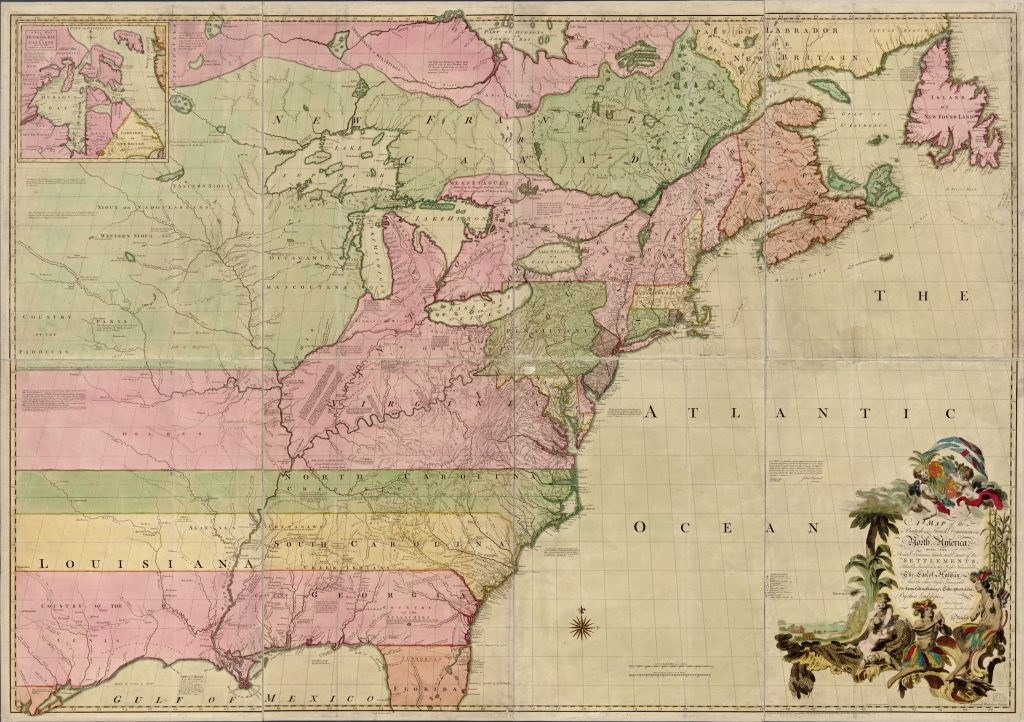
A map of the British and French dominions in North America · 1755 Rivers, mountains, and settlements anchor competing imperial claims in North America. The boundaries on this British-oriented map sit atop the territories of Indigenous nations with political orders of their own.John Mitchell (cartographer); Thomas Kitchin (engraver); Andrew Millar (publisher) · Collection record and reuse information
Imperial Maps, Indigenous Homelands
Seventeenth-century North America was a contested meeting ground of European empires and Indigenous nations. Spain expanded through southern and western regions; France developed connections along the St. Lawrence, Great Lakes, and Mississippi. Dutch merchants traded around the Hudson, while English settlers established coastal colonies. European claims on maps did not guarantee control. Native diplomacy, commerce, and military power helped determine what empires could actually do.
Founded in 1607, Jamestown became the first enduring English settlement in what is now the United States. Its early survival depended partly on exchanges with Powhatan communities, alongside recurring conflict. Tobacco cultivation increased demands for land and labor. Elsewhere, New England developed towns, fishing, farming, and shipping; middle colonies attracted varied populations; southern plantations produced export crops.
Different Colonies, Connected Economies
English colonies did not share one purpose. Virginia attracted investors seeking profits and became dependent on tobacco. Separatists at Plymouth and later Puritan migrants to Massachusetts sought religious communities. William Penn promoted toleration in Pennsylvania. Northern farms and ports, middle-colony grain production, and southern plantations required different kinds of labor and commerce. The phrase thirteen colonies conceals important differences of power, settlement, and economic interest.1
Navigation laws sought to channel colonial commerce through the English empire. In practice, legal trade and smuggling connected mainland ports with Caribbean plantations, Africa, and Europe. Northern shipbuilding, insurance, and finance also profited from commodities made by enslaved labor. The concentration of plantation slavery in the South therefore should not be confused with a slave economy whose benefits stopped at the region's borders.
The Limits of Self-Government
Colonial self-government offered unequal participation. Property, gender, religion, and racial status shaped access to power. Some settlers who sought religious freedom denied it to others. Roger Williams challenged religious coercion. Meanwhile, expanding settlement threatened Native homelands. Metacom's War, beginning in 1675, grew from these pressures. Indigenous communities took different sides.
Labor systems also hardened into inequality. European indentured servants generally owed a fixed term of service, while colonial laws increasingly made African slavery lifelong and hereditary. The arrival of captive Africans in Virginia in 1619 was significant, but it did not begin slavery throughout the Americas. Virginia's 1662 law made children's free or enslaved status follow their mother's.
How Slavery Became a Lasting System
Labor status was not identical for all people in the earliest colonies. Some people of African descent obtained freedom and property. As plantation production expanded, colonial authorities increasingly imposed lifetime, hereditary slavery and racial distinctions. Virginia's 1662 law made a child's status follow the mother, allowing enslavement even when the father was free. Law and coercion helped construct racial hierarchy rather than simply reflecting a timeless division.2
Experience varied across regions. Chesapeake tobacco production and low-country rice cultivation differed in labor organization and disease environments. Enslaved people developed kinship, religious life, practical knowledge, resistance, and negotiation under severe constraints. Ira Berlin's research emphasizes changes across regions and generations. Understanding slavery requires examining those differences rather than imagining a single plantation system unchanged from the seventeenth century to emancipation.3
Forced Migration across the Atlantic
Atlantic slave trading linked capture, coastal markets, shipping, and plantation labor. Across the entire sixteenth-to-nineteenth-century trade, an estimated 12.5 million people were embarked in Africa and 10.7 million reached the Americas, chiefly Brazil and the Caribbean. Enslaved people maintained relationships, created cultures, escaped, and resisted. Colonial prosperity and claims to liberty cannot be separated from this history of coercion.
British Subjects and Colonial Political Life
Colonists developed political experience through assemblies, town meetings, courts, and a growing print culture. Religious revivals challenged some established authorities without producing a single political outlook. These developments did not automatically lead to independence: many colonists valued their identity as British subjects. The historical problem is how people proud of British liberties came to believe that the empire threatened those same liberties.
The Seven Years' War transformed that relationship. Conflict over the Ohio country expanded into imperial warfare spanning continents. Indigenous nations pursued their own alliances and continued resisting after the European settlement. Britain acquired territory but also debt and defense obligations. Its Proclamation of 1763 sought to limit settlement beyond the Appalachians and reduce conflict, angering settlers and land speculators. Imperial victory created new disputes about land, revenue, and authority.4
A Historian's Question · Whose Liberties?
Colonial self-government and slavery were connected histories. People asserting rights in assemblies could also profit from coerced labor and territorial expansion. Berlin's attention to regional and generational variation complicates a simple free-North/slave-South division. Specific institutions differed, but trade and power connected them. Both levels are necessary to explain the society from which the Revolution emerged.3
World Connections · Beyond a Single Triangle
Atlantic commerce followed many routes connecting Europe, Africa, and the Americas. Sugar and tobacco consumption linked plantation labor to merchants, shipping, and finance. Not every vessel completed the same 'triangular trade.' Brazil and the Caribbean received most transatlantic captives, a fact easily obscured by a United States-centered map. Following commodities must not mean losing sight of the people forced to move and their resistance.
How the changes connect
01 / Conditions
Imperial rivalry, profits from export crops, and settlers' demand for land drove colonial expansion.
02 / Choices and conflict
Settlement, trade, Native alliances, and warfare reshaped the continent, while law and Atlantic trafficking strengthened hereditary slavery.
03 / Consequences
Regional economies and limited self-government developed alongside dispossession and entrenched racial bondage.
The sequence of events
English colonists founded Jamestown in Virginia.
Captive Africans arrived at Point Comfort in English Virginia.
Virginia enacted a law making children's free or enslaved status follow their mother's.
Metacom's War, also called King Philip's War, spread across New England.
The settlement of the Seven Years' War expanded British territory and influence in North America.
People and places
People
Powhatan
Also known as Wahunsenacawh, the paramount leader of an alliance of Virginia Native communities. He negotiated and clashed with Jamestown's settlers.
Roger Williams
A colonial thinker who opposed religious coercion and defended liberty of conscience. His career reveals disagreements over freedom within settler societies.
Metacom
The Wampanoag leader whom English colonists called King Philip. He led resistance to expanding settlement and political pressure, but not all Indigenous communities supported his coalition.
Places
Jamestown
An English settlement on the James River where food shortages, relations with Powhatan communities, and the growth of tobacco cultivation intersected.
Chesapeake Bay
The bay and surrounding Virginia and Maryland region. Tobacco exports, waterways, ports, and expanding coerced labor transformed its society.
The Caribbean
An island and maritime center of Atlantic commerce. Sugar plantations and slave trading connected its economy to European and North American ports.
A question to consider
If a colony with an elected assembly enacted hereditary slavery, can it simply be described as a free society?
A perspective to consider
Self-government alone does not establish freedom for everyone. Virginia's 1662 law shows that representative institutions for some could intensify bondage for others. We must ask who participated in decisions and who received the law's protections or suffered its burdens.
Britain's military victory enlarged its empire but sharpened disagreements over costs and governing authority. The next chapter follows the shift from protests against taxation to demands for independence.
The public description establishes the study's regional and generational approach. This narrative also uses public records; it does not reproduce unconsulted book passages.
This introductory narrative was written using the scholarship and records listed here. Dates are selective. Every historical image reflects choices made by its creator and must be read in context.
CHAPTER 03 / 1763–1783
The American Revolution and the Promise of Liberty
Follow the dispute over taxation and consent, the importance of French assistance, and the unequal reach of revolutionary freedom.
Main text: about 5 minPeople & places / World context / Sources
Is declaring liberty the same as securing it for everyone?
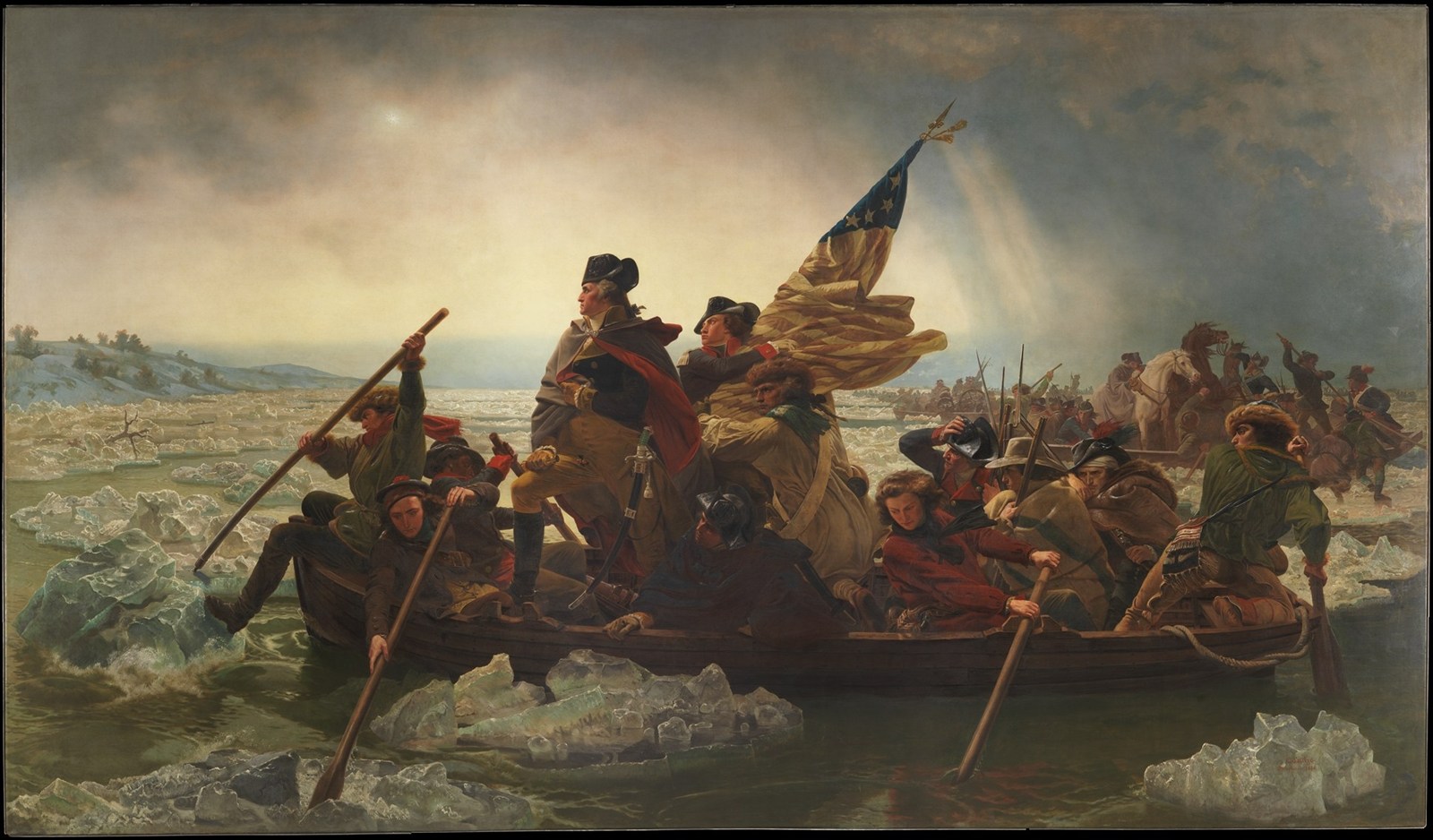
Washington Crossing the Delaware · 1851 Painted roughly seventy-five years after the Christmas crossing of 1776, this scene places Washington at its dramatic center. It reveals how later generations remembered the Revolution as a heroic national story.Emanuel Leutze · Collection record and reuse information
The Costs of War and the Question of Consent
Independence was not inevitable. Fighting between Britain and France began in North America in 1754 and became part of the global Seven Years' War. Victory in 1763 left Britain with debts and expanded defense commitments. Imperial officials expected colonists to contribute more. Colonists challenged taxation without elected representation in Parliament: the dispute concerned consent, not simply the amount paid.
The Sugar Act of 1764 and Stamp Act of 1765 provoked resistance, including boycotts. Britain's punitive response to the Boston Tea Party of 1773 encouraged intercolonial cooperation. The Continental Congress met in 1774; fighting began at Lexington and Concord in 1775. Colonists nevertheless remained divided among supporters of independence, Loyalists, and people reluctant to commit.
Why Tea Became a Political Issue
Parliament claimed to represent the interests of the entire empire, including communities that did not elect its members. Colonists countered that only their own elected assemblies could consent to internal taxation. Neither side advocated modern universal suffrage. Their dispute concerned the location of legitimate authority within the existing empire. Competing ideas of representation made agreement difficult even when both invoked the rights of British subjects.1
The Boston Tea Party was not hostility to tea itself. The Tea Act favored the East India Company's sales, while the remaining duty symbolized parliamentary taxing power. Boycotts turned purchasing and household production into political acts. Women sustained resistance through consumption and labor; artisans and waterfront workers joined public protest. British reprisals encouraged other colonies to see the dispute as a threat to liberties beyond Massachusetts.
A Declaration and an International War
Adopted on July 4, 1776, the Declaration of Independence justified separation through equality, inalienable rights, and government by the consent of the governed. Restoring rights within the empire gave way to creating independent states. Yet universal language did not establish universal citizenship. Slavery continued, and women and Indigenous peoples did not gain equal political rights.
Victory required international assistance as well as endurance. George Washington kept the Continental Army fighting despite shortages. France supplied covert aid before signing a formal alliance in 1778, following the American victory at Saratoga. Its monarchy sought to weaken Britain, not simply to promote republican ideals. French money, weapons, troops, and naval power proved crucial. At Yorktown in 1781, allied land forces and a French naval blockade compelled a British surrender.
Declaring Independence and Surviving the War
A declaration did not supply soldiers, food, shoes, or money. Congress depended heavily on the states, and the army struggled to maintain men and equipment through a prolonged conflict. Washington needed to preserve an effective force rather than destroy Britain's army in one encounter. After defeats around New York in 1776, victories in New Jersey demonstrated that resistance could survive setbacks.
French intervention made the conflict unmistakably international. Britain had to defend Caribbean possessions and sea routes as well as mainland positions. War with Spain and the Netherlands further stretched its resources. At Yorktown, combined American and French forces trapped a British army while a French fleet blocked relief by sea. Fighting continued elsewhere, but the surrender severely weakened Britain's willingness to pursue the war.2
The Unfinished Work of Victory
Britain recognized American independence in the Treaty of Paris in 1783. The outcome brought unequal opportunities: Black people had sought freedom through both armies, while Indigenous nations pursued different strategies to defend their homelands. Independence also left debts and disputes among states. Defeating royal authority was one task; constructing a government capable of preserving liberty was another.
Revolutionary Language beyond the Battlefield
The language of equality could be used beyond the intentions of the Declaration's authors. Enslaved petitioners invoked revolutionary principles, and some northern states moved toward gradual abolition. British offers of freedom under particular wartime conditions also shaped Black decisions. For many people, choosing a side concerned family and the prospect of freedom rather than uncomplicated loyalty. Indigenous nations defended distinct territorial and diplomatic interests that American victory did not secure.
American independence did not mechanically produce the French or Haitian revolutions. Each arose from its own conflicts, although debts, migration, print, and political language connected them. The Declaration also addressed other powers, asserting a claim to independent statehood and recognition. That international purpose helps distinguish the founding of a sovereign state from the unresolved question of who would enjoy full rights within it.3
A Historian's Question · Who Was the Declaration Addressing?
David Armitage locates the Declaration within international law and the world of states. Jack Rakove distinguishes its immediate political purpose from the expanding significance later attached to equality. These perspectives allow readers to take its promises seriously without projecting modern democracy backward into 1776. A document has both an original setting and a history of subsequent interpretation.34
World Connections · Royal Aid, Revolutionary Consequences
France's monarchy supported the Americans partly to weaken Britain. The expense increased French financial pressures, while American rights claims and republican government attracted discussion across the Atlantic. Yet the French Revolution of 1789 was not a copy of the American Revolution. France's social hierarchy and fiscal crisis shaped its own upheaval. The revolutions were connected, but each followed a different course within its society.
How the changes connect
01 / Conditions
Britain's postwar debts and defense commitments intensified disputes over colonial taxation and self-government.
02 / Choices and conflict
Boycotts and coordinated protests developed into armed conflict and independence, while the French alliance altered the military balance.
03 / Consequences
Britain recognized American independence in 1783, but exclusion, slavery, Native land disputes, and the challenge of building a government remained.
The sequence of events
The Seven Years' War ended, leaving Britain with debts and defense commitments that shaped colonial policy.
Resistance to the Stamp Act spread through boycotts and coordinated protests.
The Continental Congress adopted the Declaration of Independence on July 4.
After the American victory at Saratoga, France signed a formal alliance with the United States in 1778.
British forces surrendered at Yorktown; Britain recognized American independence in the Treaty of Paris in 1783.
People and places
People
George Washington
Commander of the Continental Army. He maintained the army and coordinated with French forces. Victory depended on soldiers' work and international aid as well as his leadership.
Thomas Jefferson
The principal drafter of the Declaration of Independence. He advocated natural rights and government by consent while himself enslaving people, embodying the gap between revolutionary principles and practice.
Benjamin Franklin
A diplomat in France who helped secure the alliance and assistance. He also participated in negotiating the Treaty of Paris in 1783.
Places
Boston
The port city of boycotts, the Tea Party, and Britain's port closure. Imperial trade policy and popular political resistance collided here.
Saratoga
The battle area in present-day New York where the American victory in 1777 helped persuade France to enter a formal alliance.
Yorktown
A Virginia port where allied American and French armies, supported by French naval power, isolated British forces and compelled their surrender in 1781.
A question to consider
What disappears from the story if Yorktown is described only as a victory Americans achieved by themselves?
A perspective to consider
French soldiers, ships, money, and supplies disappear. Independence was an American struggle, but also an international war shaped by imperial rivalry. Both local effort and outside assistance explain how victory became possible.
The Declaration justified separation from the king without settling how the new government should work. The next chapter follows the transformation from a loose confederation into a constitutional federation.
This introductory narrative was written using the scholarship and records listed here. Dates are selective. Every historical image reflects choices made by its creator and must be read in context.
CHAPTER 04 / 1781–1815
The Constitution and the Early Republic
Examine the transition from confederation to Constitution, compromises over slavery, party rivalry, and territorial expansion.
Main text: about 6 minPeople & places / World context / Sources
Whose liberty did the Constitution protect, and whom did it exclude?
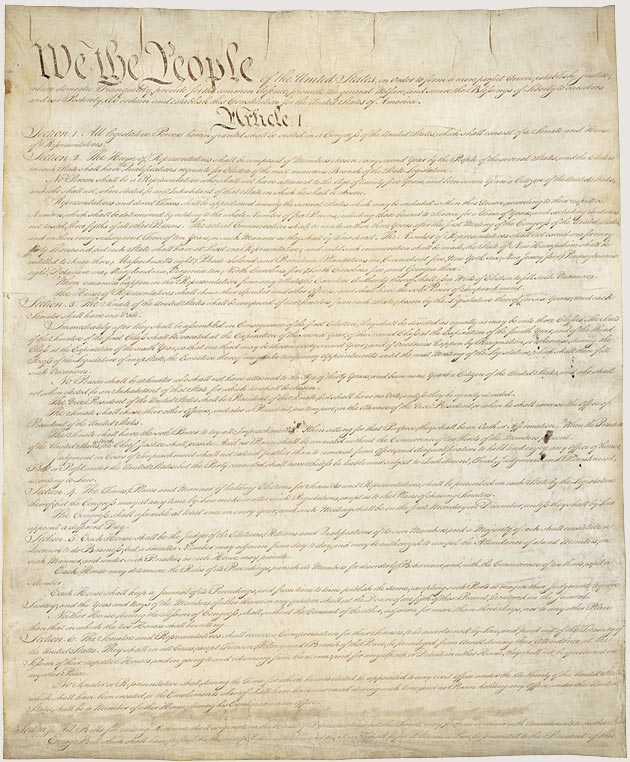
Constitution of the United States, page 1 · 1787 The Constitution opens with “We the People” and proceeds to allocate the powers of a new government. Who could fully belong to that people remained a question fought over for generations.United States Constitutional Convention · Collection record and reuse information
From Confederation to Constitution
Adopted in 1777, the Articles of Confederation took effect in 1781 as the United States' first national constitution. States retained extensive authority. Congress managed diplomacy and war but lacked independent taxing power and effective control over interstate commerce. Debt, economic instability, and Shays' Rebellion strengthened calls for reform, while opponents feared another distant, overbearing government.
In 1787, delegates in Philadelphia drafted a new Constitution. Federalism divided authority between national and state governments, while separate branches checked one another. A population-based House and a Senate with two members from each state reconciled competing state interests. Ratification remained contentious. The new government began operating in 1789. The Bill of Rights, ratified in 1791, initially limited federal power to protect individual liberties.
Institutions Built through Compromise
Separation of powers does not mean that three branches operate without connections. Vetoes, congressional overrides, confirmation, and judicial decisions create overlapping checks. Federalism likewise left important powers with states while assigning common responsibilities such as foreign relations to the union. Neither arrangement settled every boundary. Arguments about which institution or level of government could act became a continuing feature of American politics.1
The Electoral College emerged from competing concerns rather than agreement on an ideal design. Delegates worried about congressional domination of the executive, the practicalities of a national election, and differences between states. The three-fifths rule increased slave states' electoral weight as well as their representation in the House. Slavery was not the system's only origin, but its effects cannot be excluded from the account.2
Compromise and Political Rivalry
Constitutional compromise also protected slavery. Three-fifths of the enslaved population counted toward House representation and direct taxation, without granting those people votes. This increased slaveholding states' political power. Congress could not prohibit slave importation permitted by existing states before 1808, and fugitives from slavery were to be returned. A ban on imports took effect in 1808, but slavery and the domestic slave trade continued.
Political conflict continued under the new system. Alexander Hamilton promoted public credit and a national bank; Thomas Jefferson's supporters feared concentrated power. Federalists and Democratic-Republicans became rivals, but the election of 1800 led to a peaceful transfer of party control in 1801. Jefferson's Louisiana Purchase in 1803 expanded American territorial claims without extinguishing the rights of Indigenous inhabitants.
Banks, Taxes, and the First Parties
Hamilton sought federal assumption of war debts and a national bank to establish public credit and support commerce. Jefferson, Madison, and other critics feared concentrated financial and political power. They also disputed whether the Constitution authorized the bank. The emerging party struggle concerned the future economy and the interpretation of federal authority, not merely personal hostility among founders.3
Resistance to the whiskey excise in western Pennsylvania exposed these tensions in everyday life. Farmers distilled bulky grain into a transportable product, making the tax a material burden. Washington's government needed revenue and asserted its capacity to enforce federal law. Understanding the 1794 rebellion requires considering both sides of that problem: maintaining a functioning republic and deciding how its costs should be distributed.
Rights on Paper and Power in Practice
The Alien and Sedition Acts of 1798 used fears surrounding conflict with France to pressure immigrants and government critics. Opposition brought freedom of political criticism into partisan conflict. The transfer of power after the 1800 election mattered because the losing side relinquished office, although the election also exposed constitutional defects and required a decision in the House. Peaceful succession was a political achievement, not an automatic outcome of institutional design.
In Marbury v. Madison in 1803, the Supreme Court held a provision of a federal statute incompatible with the Constitution. The decision became foundational for judicial review, but it did not settle every dispute about judicial power. Early republican experience shows a Constitution taking practical form through courts, parties, elections, and public action. Its written arrangements required interpretation and remained subject to conflict.4
The Republic Survives to 1815
Napoleonic warfare disrupted American trade. British restrictions, the impressment of American sailors, and western conflicts helped produce the War of 1812. American invasions of Canada failed, and British forces burned public buildings in Washington. Signed in December 1814 and effective in 1815, the Treaty of Ghent largely restored prewar boundaries. The American victory at New Orleans came in January, before news of the treaty arrived. The republic endured, but Indigenous resistance suffered serious setbacks. Its future still joined liberty to slavery and expansion.
A Historian's Question · One Founding Intention?
Rakove's public explanation presents constitution-making as a search among contested alternatives. Delegates could approve the same provision for different reasons and with different expectations. Taking those disagreements seriously helps readers understand both the document's origins and its subsequent operation. Claims about what the founders intended should identify particular actors, circumstances, and evidence instead of assuming a single, unanimous mind.2
World Connections · Haiti and Louisiana
The uprising in Saint-Domingue began in 1791 and culminated in Haitian independence in 1804. Black resistance and the failure of France's expedition weakened Napoleon's American ambitions and helped make the Louisiana sale possible. United States expansion thus intersected with Caribbean revolution. Yet American leaders who feared the spread of slave rebellion withheld recognition of Haiti. Shared language about freedom did not produce identical political choices.
How the changes connect
01 / Conditions
Financial and commercial weaknesses under the Articles, together with political unrest, encouraged demands for a stronger common government.
02 / Choices and conflict
Constitutional debate, ratification, and the Bill of Rights established the federal system, while slavery compromises, party conflict, and expansion shaped its operation.
03 / Consequences
The republic survived political turnover and war but entered an era of expansion without resolving slavery or Indigenous dispossession.
The sequence of events
The Articles of Confederation were adopted in 1777 and took effect after unanimous state ratification in 1781.
The Constitution was signed in 1787, secured the required ratifications in 1788, and established the government that began operating in 1789.
The Bill of Rights was ratified and the First Bank of the United States was established.
The election of 1800 led to a peaceful party transfer in 1801; the Louisiana Purchase followed in 1803.
War with Britain was followed by the Treaty of Ghent's signing in 1814, the Battle of New Orleans in January 1815, and the treaty's entry into force.
People and places
People
James Madison
A central figure in drafting and defending the Constitution who later helped shape the Bill of Rights. As president, he led the country during the War of 1812.
Alexander Hamilton
The first treasury secretary, who emphasized debt funding, public credit, and a national bank. His policies provoked arguments over federal power and constitutional interpretation.
Thomas Jefferson
A Democratic-Republican leader and the third president. Although wary of concentrated national power, he greatly expanded American territorial claims through the Louisiana Purchase.
Places
Philadelphia
The city of the Constitutional Convention in 1787. Where independence had been declared, delegates now debated how to govern a union of states.
Louisiana Territory
The vast region whose territorial claims the United States purchased from France in 1803. Much larger than today's Louisiana, it contained the homelands of many Indigenous nations.
New Orleans
The crucial Mississippi River port sought in the Louisiana negotiations and the site of the January 1815 battle between British and American forces.
A question to consider
Did the Three-Fifths Clause grant an enslaved person three-fifths of a white person's rights?
A perspective to consider
No. It was a population-counting rule for apportioning House seats and direct taxes among states. Without enfranchising enslaved people, it increased slaveholders' representation and influence in the Electoral College. Being counted for apportionment was not the same as possessing political rights.
After 1815, transportation, markets, and western settlement accelerated change. The next chapter examines how growth could expand political participation while also advancing Indigenous removal and slavery.
The original text documents branches, checks, representation, and presidential selection. Later amendments must be distinguished from the original provisions.
Explains electoral selection as a compromise among contested alternatives. The effects of slavery are also checked against constitutional representation provisions.
This introductory narrative was written using the scholarship and records listed here. Dates are selective. Every historical image reflects choices made by its creator and must be read in context.
CHAPTER 05 / 1803–1860
Territorial Expansion, Slavery, and Indigenous Removal
As American territorial claims expanded westward, conflicts over land, labor, and sovereignty intensified.
Main text: about 5 minPeople & places / World context / Sources
What did expansion mean to people whose land and freedom were taken in the name of opportunity?
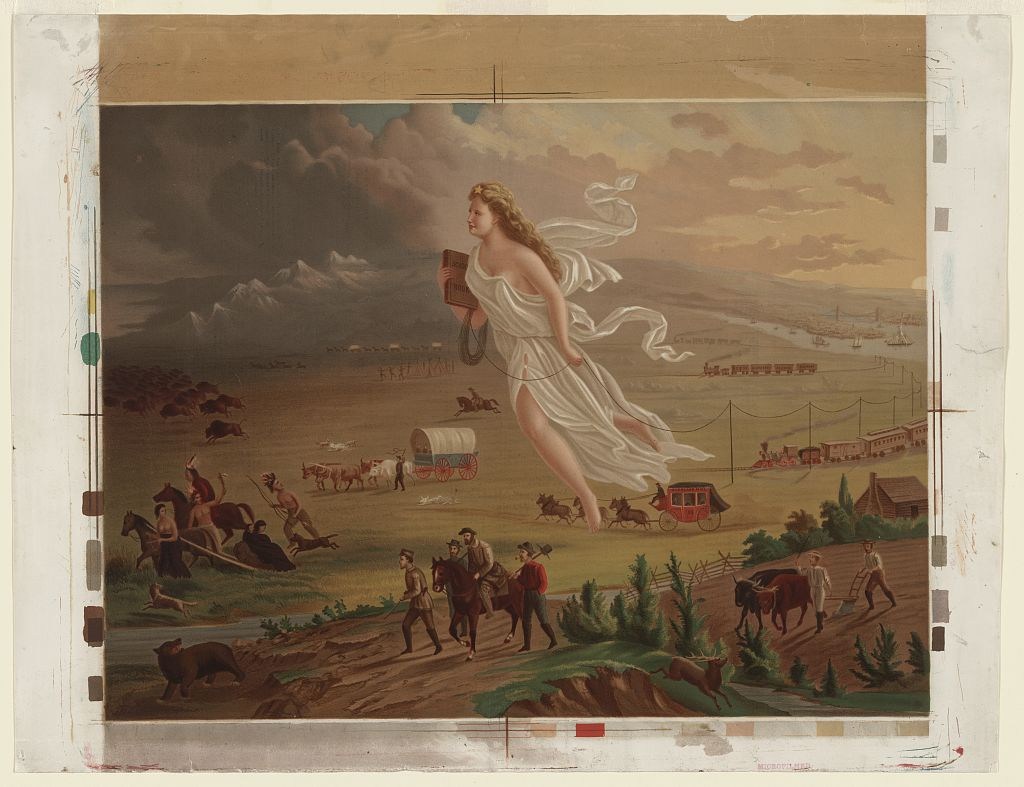
American progress, after John Gast's 1872 painting · 1873 An 1873 print after John Gast’s 1872 painting. Light moves westward alongside railroads and telegraph wires, while Indigenous people and bison retreat. The equation of expansion with inevitable progress is the historical viewpoint to examine here.George A. Crofutt (cataloged print creator/publisher), after John Gast (painter of the 1872 original) · Collection record and reuse information
Expanding Borders and the Cotton Economy
In 1803, the United States purchased Louisiana from France, greatly expanding its territorial claims. The sale did not erase Indigenous nations' rights to their homelands. Settlers, land speculators, and government officials pursued expansion through treaties, pressure, and force. Their success was neither natural nor predetermined.
Cotton linked expansion to slavery. British and northern American textile mills, merchants, and lenders benefited from cotton grown by enslaved workers. The United States prohibited overseas slave imports in 1808, but its domestic slave trade continued. Forced sales carried people into expanding cotton districts and separated families. Enslaved people resisted through escape, disrupted work, and community building.
Cotton, Credit, and Forced Migration
Cotton-processing technology helped expansion, but machinery alone did not cause slavery's growth. British textile demand, land acquisition, credit, transport, and laws protecting human ownership operated together. Plantation owners treated people as property for sale and finance. Northern merchants and European investors also profited. Industrial factories and slave plantations belonged to connected economies rather than separate modern and backward worlds.
For enslaved families, expansion threatened forced separation through the domestic trade from the Upper to the Deep South. People preserved memories, sought relatives, and built communities despite those pressures. Frederick Douglass used autobiography, speeches, and newspapers to challenge slaveholders' accounts. Antislavery drew on religion, rights, free-labor ideas, and sometimes racial exclusion; opposition to expansion did not necessarily imply support for equal citizenship.1
Indigenous Sovereignty and Forced Removal
The Indian Removal Act of 1830 supported efforts to push southeastern Indigenous peoples west of the Mississippi. Cherokee leaders defended their sovereignty through petitions, constitutional government, and litigation. Federal authorities nevertheless enforced a removal treaty rejected by most Cherokee people. During the forced migrations of 1838–1839, known as the Trail of Tears, confinement, hunger, and disease killed many. Survivors rebuilt communities in the West.
Removal as a Policy Made and Enforced
Cherokee people adopted a written constitution, published a newspaper, and sought protection in American courts. None of those actions guaranteed sovereignty against Georgia, federal authorities, and white demand for land. Removal involved legislators, soldiers, transport contractors, and land buyers. Following who acquired the dispossessed land explains more than an account of timeless cultural hostility. It was an organized policy with identifiable agents and beneficiaries.2
Expansion also involved interstate warfare. Texas was annexed in 1845 after independence from Mexico; competing border claims and expansionist ambitions helped produce war in 1846. Americans themselves disputed its justification. After conquest, residents faced questions of nationality, property, language, and participation. A changed map did not transform every life immediately, but the new legal and political order reshaped opportunities and landholding over time.
New Territories, Unstable Compromises
In the 1840s, supporters of expansion invoked Manifest Destiny to justify taking more territory. Texas annexation and war with Mexico brought further gains. The Treaty of Guadalupe Hidalgo in 1848 transferred vast western lands to the United States. Indigenous and Mexican residents faced new threats to land and rights. Each acquisition sharpened a political question: would slavery be permitted there?
The Missouri Compromise and the Compromise of 1850 temporarily contained sectional conflict without resolving it. Federal enforcement of the Fugitive Slave Act extended slavery's reach into northern communities. Violence followed the Kansas–Nebraska Act of 1854. Lincoln's election in 1860 convinced southern leaders that slavery's future was endangered. Civil war was not the inevitable price of national growth. Secession to protect slavery turned a political crisis into an armed struggle.
Why Compromise Failed to Settle Slavery
The Missouri Compromise balanced states and restricted slavery in part of the West without resolving its legitimacy. The Kansas-Nebraska Act of 1854 appealed to popular sovereignty, but conflict over settlement, voting, and enforcement produced violence. Local choice did not remove the national dispute. Established parties fractured, and Republicans organized around opposition to slavery's territorial expansion.3
Dred Scott v. Sandford in 1857 rejected Scott's freedom claim and denied federal citizenship to people of African descent while attacking congressional restriction of territorial slavery. Rather than ending controversy, it intensified it. John Brown's 1859 raid heightened slaveholders' fears. Secession after Lincoln's election and the attack on Fort Sumter turned the crisis into war. Regional identities and constitutional arguments cannot be separated from slavery's central role.4
A Historian's Question · Was Removal Inevitable?
Claudio Saunt's research challenges the treatment of removal as an inevitable accompaniment to expansion. The University of Georgia's public discussion emphasizes dispossession as a historical problem involving policy and action. This approach directs attention to decision-makers, material interests, administration, and alternatives. It replaces an assumption of destiny with questions about how particular choices imposed costs on particular people.2
The Haitian Revolution and the Atlantic Cotton Economy
The revolution and resistance of enslaved people in Haiti undermined France's Caribbean ambitions. Together with the pressures of European warfare, this helped persuade Napoleon to sell Louisiana. Meanwhile, British textile factories relied on southern American cotton. Revolutionary struggles for freedom and industrial demands that expanded slavery belonged to the same interconnected Atlantic world. American expansion cannot be explained by domestic politics or a supposed pioneering spirit alone.
How the changes connect
01 / Conditions
Demand for farmland and cotton profits, land speculation, and government expansion policies drove territorial acquisition.
02 / Choices and conflict
Purchases, annexation, war, and Indigenous removal enlarged American control, while slavery's status in new territories became a national controversy.
03 / Consequences
Forced migration increased, and sectional conflict over slavery's future intensified.
The sequence of events
The Louisiana Purchase greatly expanded American territorial claims.
Congress passed the Indian Removal Act.
Cherokee people endured the forced migrations known as the Trail of Tears.
War with Mexico and the Treaty of Guadalupe Hidalgo brought vast western territories under American control.
After Lincoln's election, South Carolina declared its secession from the Union.
People and places
People
Andrew Jackson
The seventh president symbolized expanded political participation for white men while promoting Indigenous removal and signing the Indian Removal Act.
John Ross
A Cherokee leader who opposed removal through petitions and diplomacy. During forced migration, he worked to protect his people and rebuild their community.
Frederick Douglass
After escaping slavery, Douglass exposed its violence through speeches and writing. He insisted that Black people were political actors demanding rights, not passive recipients of freedom.
Places
The Louisiana Purchase Territory
A vast region west of the Mississippi, not simply today's Louisiana. The transaction between France and the United States did not extinguish Indigenous land rights.
Indian Territory
A region encompassing much of present-day Oklahoma, where displaced Indigenous communities settled and rebuilt political institutions.
Kansas
A territory where armed conflict over slavery erupted in the 1850s, turning western settlement into a national political crisis.
A question to consider
If a government purchases territory from another country, has it also purchased the land and political rights of the people living there?
A perspective to consider
A transaction between states must be distinguished from residents' rights. The Louisiana Purchase transferred French territorial claims; it did not establish Indigenous consent to surrender land or sovereignty.
Conflict over slavery in new territories became a struggle over the Union's survival. The next chapter examines how war transformed emancipation and how Americans contested freedom afterward.
Explains Foner's analysis of antislavery and racial motives within free-soil politics; opposition to expansion is distinguished from support for equal rights.
Establishes the focus of Saunt's removal research. Public discussion and historical records are used without invented quotations or page citations from the book.
This introductory narrative was written using the scholarship and records listed here. Dates are selective. Every historical image reflects choices made by its creator and must be read in context.
CHAPTER 06 / 1861–1877
The Civil War and Reconstruction
War destroyed slavery, but Reconstruction brought new struggles over citizenship and the meaning of freedom.
Main text: about 6 minPeople & places / World context / Sources
What separated the abolition of slavery from equal citizenship?
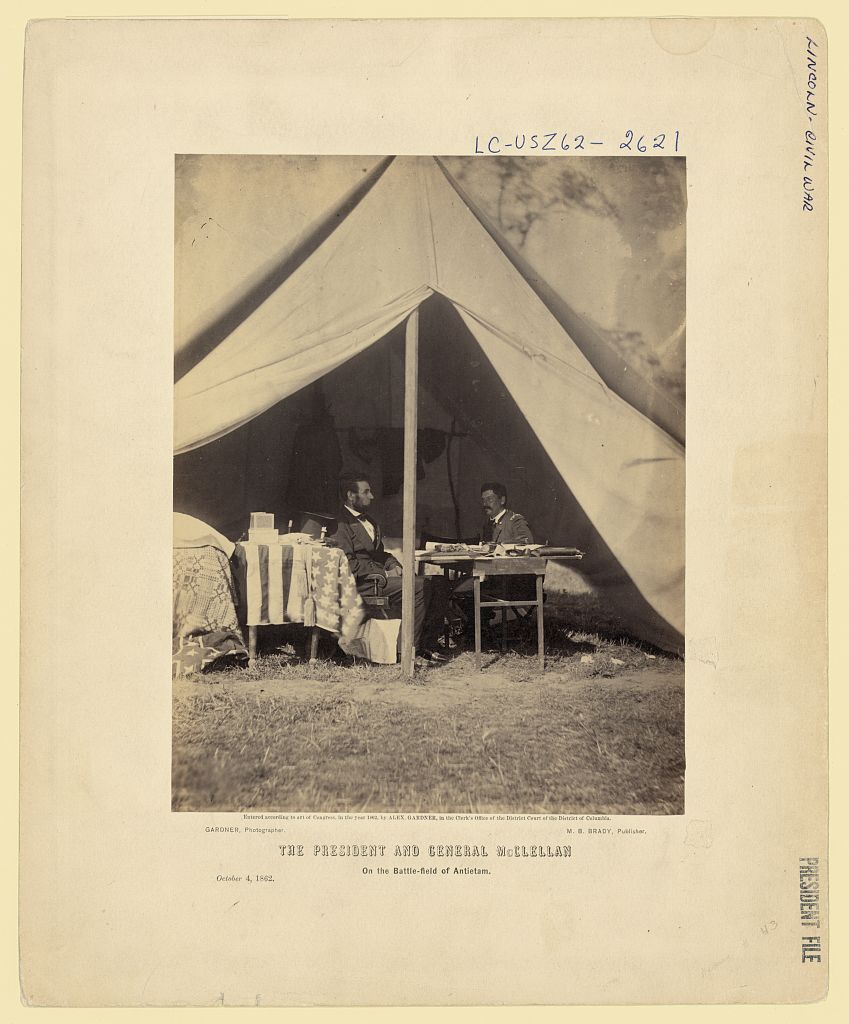
The President and General McClellan on the Battle-field of Antietam · 1862 Lincoln visits George McClellan after the Battle of Antietam. Their disagreements over how to conduct the war show that Union strategy and war aims were contested rather than settled from the beginning.Alexander Gardner (photographer); M. B. Brady (publisher) · Collection record and reuse information
A War Over Slavery, a Struggle for Emancipation
The Civil War began in 1861 after southern secession. Its central cause was conflict over slavery's survival and expansion. Confederate leaders defended states' rights above all to protect slaveholding. Yet Union supporters did not share a single purpose. Lincoln initially prioritized preserving the Union, which included several slave states. Opposition to secession did not necessarily mean support for racial equality.
Enslaved people helped transform the war by escaping plantations, reaching Union lines, and demanding freedom. Black military service strengthened emancipation's place in Union policy. Lincoln's Emancipation Proclamation of 1863 applied to designated areas in rebellion, not every enslaved person nationwide. It nevertheless made emancipation a Union war objective. Union victories at Gettysburg and Vicksburg were important, but superior resources alone did not guarantee the outcome.
Resources, Strategy, and the Changing War
The Union held advantages in population, manufacturing, transport, and finance, but those resources had to be mobilized effectively. Confederate leaders hoped that resistance would exhaust northern political will. Blockade, control of the Mississippi, leadership, and logistics shaped outcomes. Disease killed alongside weapons. Both societies experienced conscription disputes, inflation, bereavement, and arguments over the burden of war.1
After Antietam, Lincoln announced preliminary emancipation; the final proclamation took effect in 1863. Enslaved people's flight and Union advances helped turn policy into practical freedom. Black military service strengthened claims to citizenship. Union military gains in 1864 also affected electoral politics and Lincoln's reelection. Strategy, politics, emancipation, and the actions of enslaved people belong in a connected explanation of victory.
War Ends, Reconstruction Begins
In 1865, major Confederate armies surrendered, and the Thirteenth Amendment abolished slavery, with an exception for punishment following criminal conviction. Reconstruction asked what freedom would mean in practice. After Lincoln's assassination, President Andrew Johnson favored lenient restoration of southern white governments. Their Black Codes restricted freedpeople's labor and mobility, helping prompt stronger congressional intervention.
What Did Freedom Mean to Freedpeople?
Freedom could mean reuniting families, learning to read, moving without permission, and choosing working conditions. Freedpeople and Black soldiers sought land and security as well as wages. Some wartime and postwar arrangements offered or promised land locally, but no lasting nationwide policy guaranteed land to all formerly enslaved people. Much property returned to former owners, leaving many laborers dependent on unequal contracts.
The Freedmen's Bureau addressed relief, health, schooling, labor contracts, and family records. Black communities and teachers treated education as a condition of freedom; women sustained schools, churches, and kinship networks. Bureau resources and local practices varied. A signed contract did not necessarily indicate equal bargaining power. Sharecropping and indebtedness reveal why formal freedom and economic independence remained distinct, connected struggles.2
New Rights and the Retreat from Protection
Reconstruction achieved substantial changes. The Fourteenth Amendment established birthright citizenship and equal protection; the Fifteenth prohibited denying voting rights because of race, color, or previous enslavement. Black men voted and held office. Interracial governments expanded public education, while freedpeople reunited families and established churches and schools. Yet women remained excluded from constitutional voting protections based on sex. Widespread land redistribution never occurred, and sharecropping and debt constrained economic independence.
White supremacist violence attacked these gains. Federal enforcement sometimes checked terrorism, but weakening northern commitment, economic crisis, and restrictive court decisions undermined protection. In 1877, federal military support for the remaining Republican state governments ended. Disfranchisement and segregation expanded afterward. Reconstruction left enduring constitutional tools, even as governments failed to enforce them. Neither its achievements nor their reversal was inevitable.
Who Would Protect Political Rights?
Violence against Black political participation aimed to change elections and restore control, not merely express private prejudice. Federal enforcement legislation helped suppress the Ku Klux Klan, but white-supremacist organizing continued in other forms. Economic crisis, partisan calculation, court decisions, and weakening political commitment reduced federal protection. Exercising a constitutional right could remain dangerous when the government responsible for protecting it would not act effectively.3
Federal protection did not disappear everywhere overnight in 1877. Local circumstances varied, and disenfranchisement and segregation expanded over subsequent decades. Yet the Reconstruction amendments endured as resources for later movements. Schools and political institutions were substantial achievements. Assessing Reconstruction requires identifying what people built and how violence, unequal property relations, and retreat undermined those gains, rather than reducing the entire period to one verdict.
A Historian's Question · Who Wrote Reconstruction's History?
W. E. B. Du Bois's Black Reconstruction treated Black people as historical agents. In an American Historical Association discussion, Eric Foner, Elizabeth Hinton, and others revisit how racist historical interpretations marginalized that work. Historians' assumptions influence which evidence they value. Studying Reconstruction therefore includes examining both the period itself and the changing accounts through which later generations understood it.4
Different Paths to Emancipation in the United States and Brazil
American emancipation belonged to a wider Atlantic struggle against slavery. In Brazil, resistance by enslaved people and abolitionist organizing contributed to successive legal changes, culminating in abolition in 1888. Unlike the United States, Brazil did not abolish slavery through a nationwide civil war. Yet in both societies, legal freedom did not produce an equal distribution of land, education, or political power. Comparing emancipation requires attention to both the route to abolition and people's lives afterward.
How the changes connect
01 / Conditions
Southern leaders seceded to protect slavery's survival and expansion, while the federal government resisted disunion.
02 / Choices and conflict
Warfare, escape from slavery, and Black military service advanced emancipation; constitutional amendments and Black political participation then reshaped Reconstruction.
03 / Consequences
Slavery ended and citizenship acquired new constitutional foundations, but violence and retreat from federal protection severely constrained equality.
The sequence of events
Southern secession and the attack on Fort Sumter brought the outbreak of civil war.
The Emancipation Proclamation took effect, and Union forces won at Gettysburg and Vicksburg.
Major Confederate armies surrendered, and the Thirteenth Amendment was ratified.
The Fourteenth and Fifteenth Amendments were ratified in succession.
Federal military protection sustaining the remaining southern Republican state governments was withdrawn.
People and places
People
Abraham Lincoln
The president initially prioritized preserving the Union, then issued the Emancipation Proclamation and supported constitutional abolition. Emancipation also depended on Black action and political pressure.
Hiram Revels
In 1870, Revels became the first Black United States senator, representing Mississippi. His service demonstrates that Reconstruction created substantive political change.
Ulysses S. Grant
A Union commander and later president who used federal law enforcement and military power against Ku Klux Klan terrorism to protect Black political rights.
Places
Fort Sumter
A federal fort in Charleston Harbor, South Carolina. Its bombardment by Confederate forces in 1861 marked the beginning of full-scale war.
Vicksburg
A strategic city overlooking the Mississippi River. Its capture in 1863 was crucial to Union control of the river.
Beaufort
A coastal South Carolina city. During the war, nearby Sea Islands became important sites of freedpeople's education and experiments in wage labor.
A question to consider
Can Reconstruction be adequately described by the single word 'failure'?
A perspective to consider
Constitutional amendments, expanded public education, and Black officeholding were substantive achievements. At the same time, protection of land access, personal safety, and voting rights weakened. Distinguishing gains from reversals helps explain what changed and who undermined those changes.
As war and Reconstruction drew to a close, the economy was changing rapidly. The next chapter examines factories, railroads, migration, and labor movements to explore industrial growth and its costs.
This introductory narrative was written using the scholarship and records listed here. Dates are selective. Every historical image reflects choices made by its creator and must be read in context.
CHAPTER 07 / 1865–1900
Industrialization, Immigration, and Labor
Railroads and factories created wealth, but its distribution and workers' rights remained fiercely contested.
Main text: about 5 minPeople & places / World context / Sources
Whose labor built industrial growth, and how were its rewards and risks distributed?
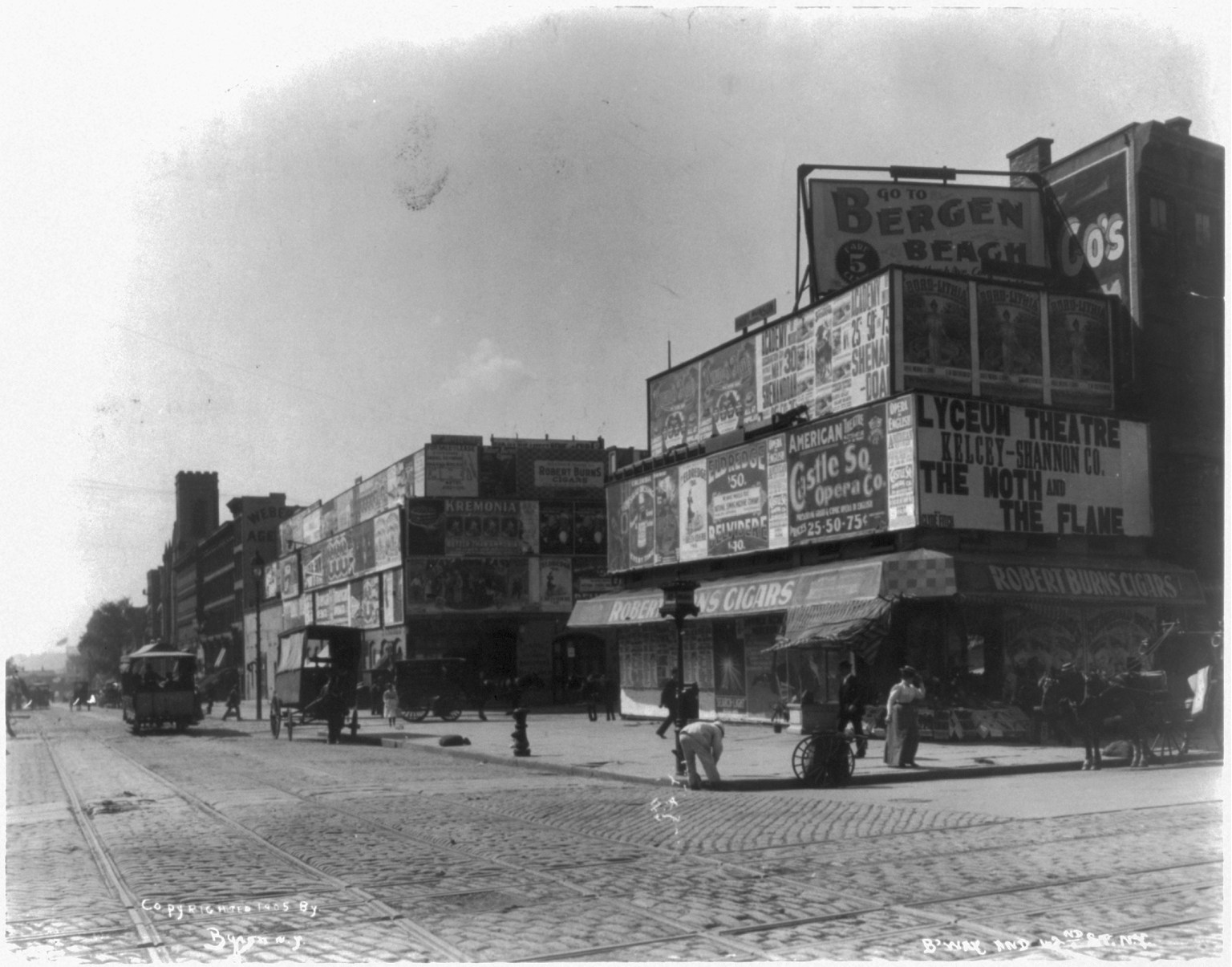
Broadway and 42nd St., N.Y. · 1905 Advertisements, traffic, and a street-cleaning worker share a New York intersection. The industrial city’s bustle depended on expanding commerce and on the many people whose labor kept its streets moving.Byron, New York / Library of Congress · Collection record and reuse information
Railroads, Corporations, and a National Economy
After the Civil War, railroads and factories transformed the United States. The first transcontinental railroad was completed in 1869. Natural resources, new technologies, investment, and government support helped connect regional economies. Expansion also dispossessed Indigenous peoples and disrupted their livelihoods. Industrial growth depended on workers and public resources, not simply the brilliance of individual entrepreneurs.
Large corporations gained control over steel, oil, and rail transport through mergers and coordinated production and distribution. Mass production lowered some prices and expanded consumption, but wealth and influence became highly concentrated. Recessions brought unemployment and wage cuts. Farmers challenged freight charges and credit arrangements. Government both supported business and responded to demands for regulation, including the Sherman Antitrust Act of 1890.
Corporations, Government, and a National Market
Railroads connected distant farms and urban consumers while giving companies influence through routes and rates. Large networks required managers, accounting, telegraphs, and coordinated schedules. Corporate scale widened the distance between owners and workers. Securities linked investors across borders, but financial failures could harm workers, farmers, and savers far beyond the company's offices.
Government was not absent. Tariffs favored industries, land and subsidies supported railroads, and courts and soldiers shaped labor disputes. Richard White's public interview emphasizes a government exercising substantial power through private bodies, fees, and subsidies. The useful question is not simply whether government intervened, but whose interests its particular forms of intervention supported.1
Cities Built by Migration
Factories drew workers from rural America and overseas. European immigrants built urban communities, while Chinese migrants contributed to western railroads and mining. Churches, businesses, and mutual aid societies helped newcomers establish themselves. Crowded housing, unsafe water, insecure employment, and prejudice complicated their lives. The Chinese Exclusion Act of 1882 barred new Chinese labor immigration, revealing how sharply opportunity depended on race and origin.
Growth's Costs on the Plains and in Cities
Railroads and machinery offered western farmers markets but also debt. Falling crop prices could make fixed obligations harder to repay; freight and storage charges reduced earnings. Cooperatives, alliances, and the Populist movement sought changes in credit, transport, and political power. Rural protest concerned control over a new economy, not simply rejection of technology.
For Plains Native peoples, settlement and railroad expansion accompanied shrinking territories and military pressure. The Dawes Act divided collectively held lands into individual allotments and opened land labeled surplus to outsiders. Officials presented assimilation as progress, but landholding and collective authority contracted. Boarding schools separated children from families as another instrument of assimilation. National market integration must be read alongside those losses.2
Organized Labor and Government Choices
Workers organized against long hours, low pay, and dangerous conditions. The Knights of Labor attempted broad organization; the American Federation of Labor, founded in 1886, concentrated largely on skilled workers' economic demands. Many unions marginalized women, Black workers, and the unskilled. Some supported anti-Chinese exclusion. Major strikes and the Haymarket affair made labor conflict a national political issue without producing a unified working class.
In 1894, a strike at Pullman spread through a railroad boycott led by Eugene Debs's union. Federal injunctions and troops helped defeat it. Economic growth did not automatically produce labor rights. Yet workers, farmers, and urban reformers made corporate power and government responsibility subjects of public debate. By 1900, the United States was an industrial giant, but its wealth remained unequally shared.
Jobs, Security, and Collective Action
Employment did not eliminate insecurity. Workers faced layoffs, injuries, disease, and limited protection; women and children worked in many industries. Housing and sanitation could not be fixed through individual thrift alone. Mutual-aid associations, religious communities, and unions shared risks. For many families, a secure livelihood and resilience in illness or old age mattered more than limitless accumulation.3
Railroad and Pullman strikes disputed corporate authority and government responsibility as well as wages. Unions sought collective bargaining strength but differed over inclusion across occupations, race, and gender. Shared vulnerability did not guarantee solidarity. By century's end, industrial production and urban culture offered new opportunities while exposing the gap between a growing economy and secure, equal lives for its inhabitants.
A Historian's Question · Other Gilded Age Possibilities
White challenges accounts that reduce the era to individualism, drawing attention to ideals of household security and cooperation. Explaining the emergence of modern corporate America also requires examining aspirations that were frustrated. Knowing the eventual outcome should not make contemporary choices and expectations seem predetermined.1
Capital and Labor Across Borders
American industry relied on European investment and workers who crossed both the Atlantic and Pacific. Steamships and railroads widened mobility, but poverty, persecution, and family decisions also shaped migration. Immigrants maintained relationships through letters and remittances while transforming American communities. Immigration was therefore more than a story of the United States receiving outsiders. Chinese exclusion revealed that a globally connected economy did not guarantee equal freedom of movement.
How the changes connect
01 / Conditions
Resources, technology, domestic and foreign investment, government support, and a growing labor force sustained industrial expansion.
02 / Choices and conflict
Railroads and large corporations integrated markets and drew migrants into cities, while workers used unions and strikes to demand better conditions.
03 / Consequences
Production and consumption increased, but concentrated wealth, insecure work, and discrimination generated demands for regulation and social reform.
The sequence of events
The first transcontinental railroad was completed.
A major railroad strike spread across multiple regions.
The Chinese Exclusion Act barred new Chinese labor immigration.
The Haymarket affair occurred, and the American Federation of Labor was founded.
The federal government intervened in the Pullman strike and railroad boycott.
People and places
People
Andrew Carnegie
A Scottish immigrant who built a major steel enterprise and funded libraries. His philanthropy coexisted with bitter labor conflict at his company's Homestead works in 1892.
Samuel Gompers
A leader of the American Federation of Labor who emphasized better wages, hours, and working conditions, primarily through organizing skilled workers.
Eugene Debs
The American Railway Union leader who organized a boycott in solidarity with Pullman workers in 1894. He was imprisoned for defying an injunction and later entered socialist politics.
Places
Promontory Summit
The Utah location where eastern and western rail lines met in 1869, marking completion of the first transcontinental railroad.
New York City
A port city shaped by immigrant labor and commerce. Tenements and street markets combined economic opportunity with crowding and poverty.
Pullman, Chicago
The site of a railroad-car factory and company-owned housing. Conflict over wages and living costs expanded into a national railroad dispute in 1894.
A question to consider
Does a company necessarily provide security when it supplies both jobs and housing?
A perspective to consider
Housing quality must be considered alongside wages, rent, job security, and bargaining rights. At Pullman, wage reductions were not matched by lower rents. When one employer controls several conditions of everyday survival, dependence and conflict may increase.
Who should correct the inequalities of industrial society, and how? The next chapter explores social reform alongside expanding American power overseas and wartime mobilization.
This introductory narrative was written using the scholarship and records listed here. Dates are selective. Every historical image reflects choices made by its creator and must be read in context.
CHAPTER 08 / 1890–1920
Progressivism, Imperialism, and World War I
The United States expanded public responsibility at home while extending domination abroad and restricting dissent during war.
Main text: about 5 minPeople & places / World context / Sources
Who benefited from promises to expand democracy, and who remained excluded?
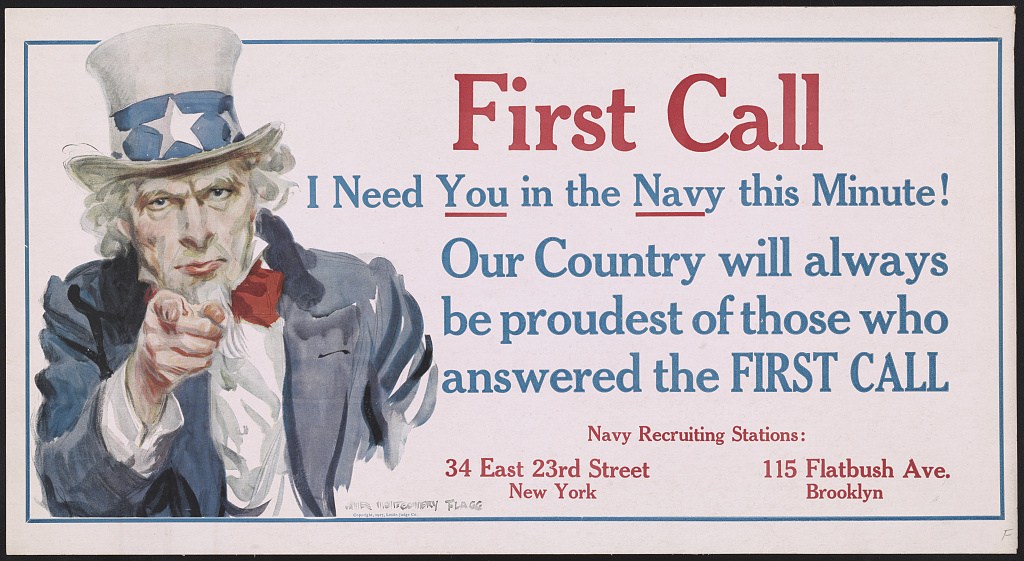
First call: I need you in the Navy this minute! · 1917 Uncle Sam addresses the viewer directly with an urgent appeal to enlist. Text, gaze, and gesture turn a distant war into a personal obligation. Mobilization worked through images and language as well as factories and armed forces.James Montgomery Flagg · Collection record and reuse information
Many Reforms, Unequal Citizenship
From the 1890s, reform movements challenged urban poverty, corporate power, and political corruption. Collectively called Progressivism, they pursued different goals. Investigative journalists exposed abuses, settlement workers such as Jane Addams provided neighborhood services, and workers and women demanded safety and political influence. They did not assume that economic growth alone would solve social problems.
Theodore Roosevelt supported selected antitrust actions, consumer protection, and conservation. State and local reforms addressed health, working conditions, and elections. The Nineteenth Amendment in 1920 prohibited denying voting rights on account of sex. This major achievement did not remove racial barriers: poll taxes, literacy tests, and violence still excluded many Black women. Some reformers themselves supported segregation and eugenics.
Where Reformers Found Their Answers
Factory fires, unsafe food, and urban disease made risks visible that individual effort could not manage. Reformers used investigation and statistics to make public claims. Settlement houses offered services while documenting neighborhood conditions. Exposure attracted attention, but organization, legislation, and enforcement produced durable change. Businesses themselves differed: some resisted regulation, while others supported common standards for competition.1
Reform ideas also crossed the Atlantic. Americans studied European municipal government, social insurance, and labor protection, then adapted proposals to federalism, courts, and racial politics at home. Exchange did not mean simple copying. Local experiments and demands by women and workers interacted with international learning, complicating an image of the United States as always developing in complete isolation from Europe.
Overseas Expansion and Colonial Rule
Reform at home coincided with imperial expansion abroad. After the Spanish–American War of 1898, the United States acquired Puerto Rico, Guam, and the Philippines; it separately annexed Hawaii. Cuba escaped annexation but faced extensive American interference. Philippine independence fighters resisted American rule in a war beginning in 1899. Washington declared the war over in 1902, although resistance continued. Strategic and commercial ambitions, reinforced by racism, fueled expansion, while anti-imperialists challenged it.
An Anticolonial Republic Acquires an Empire
War in 1898 grew from Cuba's independence struggle, American interests and opinion, and expanding naval ambitions. Washington invoked Cuban freedom but retained powerful influence afterward. In the Philippines, independence forces led by Emilio Aguinaldo faced a new war against American rule. Anti-imperialists disputed whether a republic could govern unwilling overseas populations. Racial hierarchies and claims of civilization joined strategic and economic arguments for expansion.2
Overseas rule did not grant inhabitants rights identical to those on the mainland. Disputes over territorial status and constitutional protections made empire an internal legal issue as well as a foreign policy. Intervention around the Panama Canal and the Caribbean connected shipping, finance, and military power. Domestic regulation and overseas domination could be pursued simultaneously by the same government and political coalition.
Mobilization and the Contradictions of Peace
The United States initially remained neutral when World War I began in 1914. Trade and finance tied it increasingly to the Allies. Germany's renewed unrestricted submarine warfare and the Zimmermann Telegram intensified pressure for intervention. In 1917, the United States declared war on Germany. Mobilization expanded federal power and accelerated Black migration northward. The Espionage and Sedition Acts also enabled repression of antiwar speech.
After the 1918 armistice, Wilson promoted a League of Nations, but the Senate rejected the Versailles treaty and the United States never joined. Self-determination was not extended equally to colonized peoples. Strikes, racial violence, and political repression marked the postwar crisis. Reform widened participation and government responsibility without eliminating imperial domination or exclusion. Its direction depended on political struggles, not an inevitable march toward progress.
Victory and Unequal Promises
World War I mobilized soldiers, workers, and resources from colonial empires as well as Europe. American entry added production and troops, while wartime government reached into daily life through finance and mobilization. Punishment of dissent exposed limits on criticism. Women's work and suffrage campaigns continued, and Black migration opened opportunities alongside new racial tensions. Participation in a national war did not guarantee equal civic treatment.
Self-determination sounded universal at the peace conference but was applied selectively. Activists in Korea, China, India, and Egypt adapted the language to their own demands. They were not passive recipients of Western promises. Erez Manela examines how existing movements used international opportunities; disappointment encouraged reconsideration of reliance on imperial powers and helped shape further anticolonial action.3
A Historian's Question · What Happens When Words Travel?
Manela's international approach asks how political language was translated and used in different settings. It connects American influence with local agency instead of making a president's statements sufficient causes of other nations' histories. A history of relationships asks what each society wanted and chose, not only what the United States did.3
Self-Determination and Asia in 1919
Wilsonian language about self-determination raised hopes among colonized peoples. Participants in Korea's March First Movement and China's May Fourth Movement connected local political demands to debates over the postwar order. Victorious powers, however, did not consistently dismantle their own or their allies' empires. These movements grew from existing resistance and transnational activist networks, not simply an American president's words. The crucial question is how different people interpreted and used the same promise.
How the changes connect
01 / Conditions
Industrial inequality and corruption encouraged reform, while commercial ambitions, strategic concerns, and racial hierarchies supported expansion abroad.
02 / Choices and conflict
Regulation and suffrage campaigns coincided with colonial acquisition and wars of resistance; American entry into World War I in 1917 expanded mobilization and state control.
03 / Consequences
Government responsibility and constitutional protection of women's voting rights grew, while racial exclusion, imperial rule, and restrictions on expression persisted.
The sequence of events
The Spanish–American War brought overseas territories under American control; Hawaii was annexed separately.
The Philippine–American War took place; resistance continued after Washington declared it over in 1902.
The Pure Food and Drug Act and the Meat Inspection Act became law.
The United States entered World War I; after the armistice, debate continued over the Versailles treaty and the League of Nations.
The Nineteenth Amendment was ratified, but racial barriers to voting remained.
People and places
People
Jane Addams
A co-founder of Chicago's Hull-House who promoted immigrant education, social services, and research. She supported women's suffrage and opposed World War I through peace activism.
Theodore Roosevelt
A president who supported business regulation and conservation while advocating naval strength and a larger American role overseas. His career illustrates the coexistence of reform and expansion.
Woodrow Wilson
The president who led American entry into World War I and promoted the League of Nations. His international democratic rhetoric coexisted with federal segregation and repression of wartime dissent.
Places
Hull-House
A settlement in an immigrant neighborhood of Chicago, combining education, care, and social research to address urban poverty.
The Philippines
An archipelago where independence fighters resisting Spanish colonialism confronted American rule, exposing tensions between American democracy and imperial power.
Versailles
The French site where the 1919 peace treaty with Germany was signed. It became associated with hopes for a League of Nations and colonized peoples' disappointment with the postwar settlement.
A question to consider
Could someone support consumer protection and women's suffrage while also supporting colonial rule or racial discrimination?
A perspective to consider
Such positions did coexist because reformers often limited the groups entitled to rights and protection. The label 'progressive' does not establish support for universal equality. Each policy must be examined for whom it benefited and whom it excluded.
After the war, mass consumption and cultural change accelerated, but prosperity coexisted with racial conflict and economic vulnerability. The next chapter follows these tensions through the 1920s and the Great Depression.
The university's description identifies activists' adaptation of Wilsonian language. This does not make American influence the sole origin of anticolonial movements.
This introductory narrative was written using the scholarship and records listed here. Dates are selective. Every historical image reflects choices made by its creator and must be read in context.
CHAPTER 09 / 1920–1945
The Great Depression, the New Deal, and World War II
Economic collapse and global war transformed the federal government's responsibilities while testing America's commitment to freedom.
Main text: about 5 minPeople & places / World context / Sources
How did economic crisis and war reshape the relationship between citizens and the state?
Migrant Mother · 1936. 3 Dorothea Lange photographed Florence Thompson and her children at Nipomo, California. The Depression was more than a movement in stock prices: it unsettled the meals and shelter of families traveling in search of work.Dorothea Lange, working for the United States Resettlement Administration · Collection record and reuse information
Prosperity on Uneven Foundations
The prosperity of the 1920s rested on uneven foundations. Cars, radios, installment buying, and stock speculation promised a modern life, but farmers struggled with debt and many households lacked purchasing power. The 1929 market crash exposed these weaknesses. Bank failures, shrinking credit and money supplies, and collapsing international trade then reinforced one another, turning a downturn into the Great Depression.
Unemployment became a family emergency rather than an abstract economic measure. People queued for food or traveled in search of work. On the Great Plains, drought and damaging farming practices produced the Dust Bowl. Herbert Hoover supported some federal intervention, but his response proved inadequate. The crisis challenged the belief that private charity and individual effort could provide sufficient protection.
From a Financial Shock to Lost Livelihoods
People who owned no shares could still suffer. Bank failures destroyed savings and reduced lending; businesses unable to obtain funds cut production and jobs. Unemployment reduced spending, weak demand pushed prices down, and falling incomes increased the real burden of fixed debts. These feedbacks carried financial distress into factories, shops, and farms rather than leaving it inside the stock market.1
War debts, reparations, American lending, and the gold standard connected national economies. Institutions responsible for stability faced disagreements and limits on coordination and authority. Federal Reserve failures contributed to the downturn's severity. Explaining the Depression therefore requires tracing policy and institutional mechanisms, not treating it as a single speculative crash or a punishment for personal moral failure.
The New Deal and Federal Responsibility
After taking office in 1933, Franklin Roosevelt launched the New Deal. Banking reforms, public employment, labor protections, and Social Security expanded federal responsibility. These measures brought relief and lasting institutional change, but recovery remained uneven. Agricultural and domestic workers were initially excluded from important protections, disproportionately disadvantaging Black workers and women. A sharp recession in 1937 exposed the recovery's fragility.
Relief, Recovery, and Lasting Institutions
New Deal policies worked on different timescales. Immediate relief, renewed economic activity, and reform against future crises were distinct goals. Deposit insurance addressed banking confidence; public works left infrastructure; labor legislation supported bargaining; Social Security created a basis for public protection against old age and unemployment. Outcomes include both current production and the institutions available to later generations.2
Policies emerged through conflict among Congress, courts, business, and labor. Farm measures could favor owners while harming some tenants and workers; major gaps remained in social and labor protections. Roosevelt's court-reorganization proposal raised concerns about executive power. The 1937 downturn exposed incomplete recovery. Judging the New Deal requires separating institutional achievements, exclusion, and the conditions necessary to end the Depression.
Mobilization and the Burdens of Victory
War transformed the economy again. After Japan attacked Pearl Harbor in 1941, the United States entered World War II. Military production and enormous federal spending greatly reduced unemployment. Women and Black Americans gained industrial jobs while continuing to face discrimination. The forced removal and incarceration of Japanese Americans revealed how severely wartime fear could undermine constitutional rights.
In August 1945, American atomic bombs devastated Hiroshima and Nagasaki. Civilian deaths and radiation injuries left an enduring moral burden. American decisions involved hopes for rapid victory, fears of invasion casualties, and military and diplomatic calculations. Japan's surrender also reflected Soviet entry into the war, blockade, conventional bombing, and decisions within Japan's leadership. Historians continue to debate their relative weight. Victory made the United States a global power with unprecedented responsibilities.
World War and the Responsibilities of Victory
War had expanded in Asia and Europe before American entry. Japan's invasion of China and German expansion formed parts of a developing global conflict. The United States supplied the Allies amid resistance to direct involvement, then entered war with Japan after Pearl Harbor and shortly afterward with Germany and Italy. Federal contracts, resource allocation, rationing, military service, and industrial work reorganized households as well as production.
The United States helped defeat Nazi Germany but also failed to admit many people fleeing Nazi persecution. At home, Japanese Americans, including citizens, faced forced removal and incarceration. These records should be assessed separately rather than made to cancel each other. Victory brought leadership in the United Nations and international economic arrangements while cooperation with the Soviet Union deteriorated. It initiated new responsibilities and conflicts rather than resolving every contradiction.3
A Historian's Question · Ending a Crisis and Changing Society
David M. Kennedy connects Depression and war while emphasizing the New Deal's institutional pursuit of security. The published chapter abstract distinguishes eventual recovery from enduring reform. This approach asks what recovered, what changed, and who benefited, rather than making a single success-or-failure label answer every question.4
A Global Depression and the Search for a New Order
The Depression spread through international credit and trade networks. Economic insecurity encouraged political radicalization, but dictatorship and war also depended on national institutions and leaders' choices. The Bretton Woods arrangements and the United Nations emerged from efforts to prevent renewed monetary instability and global conflict.
How the changes connect
01 / Conditions
Unequal purchasing power, agricultural distress, and financial weaknesses interacted with the market crash, bank failures, monetary contraction, and falling international trade.
02 / Choices and conflict
The New Deal pursued relief, recovery, and reform; wartime mobilization subsequently expanded production, government spending, and employment on a much larger scale.
03 / Consequences
Federal responsibility and American global influence expanded, while discrimination, wartime violations of rights, and the consequences of nuclear weapons remained unresolved.
The sequence of events
The stock market crashed, and the banking and economic crises deepened.
Roosevelt took office and launched the New Deal.
Congress enacted the Social Security Act and the National Labor Relations Act.
The United States entered World War II after Japan attacked Pearl Harbor.
Germany surrendered; atomic bombings and Soviet entry into the Pacific war preceded Japan's surrender.
People and places
People
Franklin D. Roosevelt
President during the Depression and most of World War II. His New Deal strengthened federal involvement in economic stability and social protection.
Frances Perkins
The first woman to serve in a U.S. Cabinet, she helped develop Social Security and labor protections as secretary of labor.
Harry S. Truman
President after Roosevelt's death in 1945. His role in the use of atomic bombs and the shaping of the postwar order remains central to debates about presidential responsibility.
Places
Wall Street
New York's financial center and a symbol of the 1929 crash. The Depression, however, extended well beyond stock speculation and involved national and international forces.
The Great Plains
An agricultural region devastated by drought and soil damage during the Dust Bowl. Many farm families lost their livelihoods and migrated.
Pearl Harbor
A U.S. naval base on Oahu, Hawaii. Japan's attack in 1941 brought the United States directly into the war.
A question to consider
Does the creation of public-works jobs prove that the New Deal completely ended the Great Depression?
A perspective to consider
It demonstrates an effect on relief and employment, not complete recovery. A fuller judgment must consider unemployment, production, the 1937 recession, monetary and banking policies, and wartime mobilization. The New Deal's lasting institutional reforms should also be distinguished from the timing and causes of recovery.
Victory increased American power without preserving unity among the wartime allies. The next chapter examines how rivalry with the Soviet Union reshaped prosperity, politics, and everyday life.
Documents Japanese American removal and incarceration. Refugee policy was separately checked against the U.S. Holocaust Memorial Museum's The United States and the Holocaust.
This introductory narrative was written using the scholarship and records listed here. Dates are selective. Every historical image reflects choices made by its creator and must be read in context.
CHAPTER 10 / 1945–1975
The Cold War, Prosperity, Korea, and Vietnam
Rising living standards at home coexisted with nuclear anxiety and devastating wars in Korea and Vietnam.
Main text: about 5 minPeople & places / World context / Sources
How did growing prosperity and prolonged warfare become experiences of the same generation?
Earthrise · 1968. 12. 24 William Anders photographed Earth from Apollo 8 in lunar orbit. Space exploration was a field of Cold War competition; images it produced also encouraged people to see Earth as a single, finite home.William (Bill) Anders / NASA, Apollo 8 · Collection record and reuse information
From Wartime Alliance to Cold War
The wartime alliance between the United States and the Soviet Union soon fractured. Ideological differences mattered, but the Cold War also grew from disputes over Germany and Eastern Europe, Soviet security concerns and domination of neighboring states, American strategic interests, and nuclear mistrust. Measures described as defensive by one government often appeared threatening to the other.
Washington pursued containment, supported European recovery through the Marshall Plan, and joined NATO. At home, anticommunist fears encouraged McCarthyism and damaged civil liberties. Meanwhile, industrial strength, consumer demand, housing finance, and veterans' benefits helped expand the middle class. Suburban homes and television symbolized prosperity, but racial barriers in employment and housing kept its rewards unequal.
Containment through Aid, Alliances, and Daily Life
Containment aimed to resist communist expansion rather than conquer every opposing state. The Truman Doctrine supported Greece and Turkey; the Marshall Plan aided European recovery. The Berlin airlift countered the blockade, and NATO institutionalized collective security. Aid, markets, military capacity, and diplomacy reinforced each other. Soviet consolidation in Eastern Europe also deepened the continent's division.1
Domestic prosperity depended on public arrangements as well as factories. Housing finance, highways, veterans' benefits, and education supported consumption and suburban growth, but racial barriers restricted access. The image of an automobile-owning household represented only part of postwar experience. Poverty persisted, while nuclear drills and loyalty investigations brought insecurity into daily life even amid rising living standards.
War on the Korean Peninsula
On June 25, 1950, North Korea launched a full-scale invasion of South Korea. The United States led a United Nations-authorized force supporting the South. The advance following the Inchon landing was reversed after Chinese forces intervened. The 1953 armistice stopped the fighting without producing a peace treaty. Koreans endured devastating casualties, displacement, and family separation; Washington expanded military spending and strengthened its East Asian alliances.
Local Histories within Global Alliances
Korea's liberation from Japanese rule in 1945 accompanied division, occupation, and domestic conflict. Rival governments formed in 1948. North Korea's invasion in 1950 transformed the conflict into international war; the UN advance and Chinese intervention changed its course. The armistice entrenched division. Korea was not simply a line on a superpower map, but a society whose people faced survival, state-building, and political choices.2
Newly independent countries also sought land reform, development, and responses to colonial legacies. American-backed governments were not always democratic, and Soviet-linked movements did not simply follow Moscow's instructions. External support could offer local leaders opportunities while militarizing conflicts. Alliances require examining constituencies, coercion, and aspirations inside each society as well as relations with a superpower.
Vietnam and the Limits of Power
Vietnam exposed the limits of interpreting local conflicts solely through containment. Anticolonial nationalism, competing political projects, and weak government legitimacy shaped the struggle. American assistance expanded into large-scale combat deployments in 1965. Heavy bombing and growing troop numbers failed to secure victory. Civilian suffering, conscription, and the gap between official claims and reported conditions strengthened opposition to the war.
The 1962 Cuban missile crisis demonstrated the danger of nuclear confrontation, while subsequent negotiations opened paths toward arms control. American combat forces withdrew after the 1973 Paris agreement, but fighting continued until South Vietnam collapsed in 1975. Oil shocks, inflation, and slowing growth also weakened confidence in uninterrupted prosperity. Americans increasingly questioned whether military power abroad and expanding consumption at home could resolve the nation's deepest problems.
Vietnam, Détente, and Changing Confidence
Vietnam combined anticolonial struggle and Cold War conflict. As intervention grew, the legitimacy and popular support of South Vietnam's government remained central. The Gulf of Tonkin resolution expanded presidential authority. Military statistics could not settle those political questions. The Tet Offensive inflicted heavy losses on its attackers but also challenged American assurances of approaching victory, intensifying public debate and antiwar action.
Confrontation coexisted with negotiation. Nuclear dangers encouraged arms-control efforts, and Nixon's 1972 visit to China exploited divisions between Beijing and Moscow. Détente sought to manage competition without ending every regional conflict. Oil shocks, inflation, and slowing growth meanwhile weakened confidence in domestic prosperity. These pressures helped create conditions for the political realignment explored in the next chapter.3
A Historian's Question · The Cold War beyond Europe
Odd Arne Westad connects the Cold War to intervention and transformation in the postcolonial world. LSE's research account emphasizes these global dimensions. This approach asks how international rivalry interacted with local goals and choices, instead of treating summit diplomacy as the whole history or blaming every regional conflict on superpowers alone.4
Local Histories Within a Global Confrontation
Korea and Vietnam were Cold War conflicts, but also struggles shaped by decolonization and state-building. Newly independent countries in Asia and Africa pursued agendas of their own. Nonalignment sought room between the superpowers, while the Sino-Soviet split exposed divisions within communism. Korean history likewise requires attention to local lives as well as alliances.
How the changes connect
01 / Conditions
Postwar shifts in power, ideological competition, security concerns, expanding spheres of influence, and nuclear mistrust intensified the American-Soviet rivalry.
02 / Choices and conflict
Washington pursued containment through aid, alliances, and military intervention. In Korea and Vietnam, local divisions and struggles over state-building intersected with international confrontation.
03 / Consequences
Alliances and military spending expanded alongside domestic prosperity, but warfare brought immense suffering, restrictions on civil liberties, and growing distrust of government.
The sequence of events
The Truman Doctrine, Marshall Plan, and creation of NATO gave containment an institutional framework.
North Korea's invasion began the Korean War; an armistice eventually halted the fighting.
The Cuban missile crisis heightened the danger of nuclear confrontation.
The United States deployed large-scale ground combat forces to Vietnam.
Fighting continued after the Paris agreement and American combat withdrawal; South Vietnam collapsed in 1975.
People and places
People
Harry S. Truman
President during the early containment strategy and American intervention in Korea. His administration expanded overseas security commitments and the use of military power.
George F. Kennan
A diplomat whose analysis of Soviet policy helped shape containment. His original ideas should not be equated with every later American military intervention.
Ho Chi Minh
A leader of Vietnamese independence and of North Vietnam. His career illustrates the intersection of anticolonial nationalism and communism.
Places
Berlin
A divided city whose occupation zones, blockade, and later wall made it a Cold War focal point. Strategic rivalry transformed movement and family life.
Panmunjom
The location where the Korean Armistice Agreement was signed in 1953. An armistice is not the same as a peace treaty ending a war.
Saigon
The capital of South Vietnam, captured by North Vietnamese forces in 1975. It was subsequently renamed Ho Chi Minh City.
A question to consider
What disappears when Korea and Vietnam are described only as wars to stop communism?
A perspective to consider
That description explains Washington's strategic rationale but obscures local histories and choices. North Korea's invasion and Chinese intervention require attention in Korea; colonial rule and political legitimacy matter in Vietnam. The wars also differed in their course and endings. In both cases, civilian experiences belong at the center of the account.
Americans who heard their country described as freedom's defender increasingly challenged discrimination at home. The next chapter follows the civil rights movement and the political realignment that accompanied it.
This introductory narrative was written using the scholarship and records listed here. Dates are selective. Every historical image reflects choices made by its creator and must be read in context.
CHAPTER 11 / 1954–1989
Civil Rights, Expanding Freedoms, and the Conservative Turn
Grassroots movements expanded rights while economic insecurity and social change helped build a new conservative coalition.
Main text: about 5 minPeople & places / World context / Sources
Why did the expansion of equal rights generate both lasting achievements and political conflict?
Demonstrators marching in the street holding signs during the March on Washington, 1963 · 1963. 8. 28 Demonstrators march in Washington for jobs and freedom. Civil rights history was made not only through famous speeches but also by people who organized locally, changed daily routines, and took collective action.Marion S. Trikosko, U.S. News & World Report · Collection record and reuse information
Turning Court Rulings Into Everyday Rights
Postwar claims to freedom coexisted with segregated schools, buses, and restaurants, especially in the South. Black citizens faced voting barriers and violence. In 1954, Brown v. Board of Education declared public-school segregation unconstitutional. Yet a court ruling could not implement itself. Lawyers, local organizers, students, and religious communities had to turn a constitutional promise into everyday practice.
Rosa Parks's arrest in 1955 helped ignite the Montgomery bus boycott. Martin Luther King Jr. became a prominent advocate of nonviolent resistance, but countless less famous participants sustained the movement. Sit-ins, Freedom Rides, and voter registration campaigns made local injustice a national issue. The 1963 March on Washington demanded jobs as well as freedom, linking civil rights to economic opportunity.
The Organization behind Not Riding a Bus
Montgomery's protest did not arise solely from one unexpected act by Rosa Parks. Jo Ann Robinson and the Women's Political Council had already organized against discriminatory bus practices. After Parks's arrest, leaflets, meetings, fundraising, carpools, churches, and volunteers sustained participation. People still needed to reach work, shop, and care for children. Movement strength depended on practical organizational labor as well as conviction.1
Litigation and direct action reinforced each other. Lawyers challenged segregation in court while demonstrators exposed its daily operation. Nonviolence meant confronting coercion while risking violence and punishment, not avoiding conflict. Federal responses also depended on elections, opinion, and disputes with states. Legal change emerged from relationships among many participants and institutions, not simply the insight of a prominent leader.
An Expanding Language of Rights
The Civil Rights Act of 1964 and Voting Rights Act of 1965 created powerful federal protections. Poverty, residential segregation, and police violence nevertheless persisted. Activists debated integration, community control, and Black self-determination. Women challenged inequalities at work and at home; Title IX prohibited sex discrimination in federally assisted education in 1972. Gay and lesbian activists and Native communities likewise organized around dignity, rights, and autonomy.
Legal Equality and Unequal Lives
Equal access to a restaurant did not mean equal access to a nearby home, job, or good school. Discriminatory lending and real-estate practices shaped neighborhoods, commuting, schooling, and wealth. Civil rights action therefore extended beyond southern segregation to northern housing, employment, and poverty. King's later attention to labor, poverty, and war reflected the gap between formal equality and living conditions.
Rights movements raised distinct issues. Women challenged workplace inequality and power within households; Black women confronted racial and gender barriers together. Indigenous claims included treaties and collective sovereignty as well as individual rights. Gay and lesbian organizing confronted policing, stigma, and legal exclusion. Understanding solidarity requires acknowledging those differences and tensions instead of compressing every movement into one demand.
Conservatism and the Role of Government
These changes unfolded alongside a growing conservative coalition. Resistance to racial integration mattered, but so did concerns about taxes, regulation, crime, and family values. Inflation, unemployment, Vietnam, and Watergate weakened confidence in government. Population shifts toward the South and West, business organizing, and religious conservatism also helped reshape electoral politics. No single backlash explains the transformation.
Elected in 1980, Ronald Reagan promoted tax cuts, deregulation, and stronger defense. Economic recovery also reflected Federal Reserve policy and broader economic forces, not presidential policy alone. Deficits, weakened unions, and unequal gains fueled continuing debate. Conservative victories did not erase earlier civil rights achievements. By 1989, Americans were still contesting how to balance government responsibility, individual freedom, majority rule, and the rights of minorities.
From Local Conservatism to National Power
Conservatism grew through suburban associations, campaigns, religious communities, and business support, not simply presidential direction. Lisa McGirr's Orange County research examines how a modern suburban setting sustained a conservative movement. Prosperity and urbanization did not predetermine a liberal direction. Anticommunism, distrust of government, taxes, schooling, and family concerns could mobilize participants for different reasons.2
Economic troubles and Watergate weakened confidence in governmental competence and honesty. Reagan linked discontent to promises about taxes, markets, and defense, but supporters assigned different weight to religion, regulation, race, and security. Explaining realignment means examining changing conditions, accumulated local organizing, and coalition-building alongside presidential rhetoric. An electoral victory condenses a longer history rather than creating it from nothing.
A Historian's Question · Is a Short Triumph Enough?
In the Journal of American History, Jacquelyn Dowd Hall challenges narratives confined to southern heroes and a brief period of legal victories. Her approach restores longer organizing histories, economic objectives, and varied participants. It makes the landmark laws more intelligible by examining the work that made them possible and the struggles that continued afterward.3
Liberation, Rights, and Markets Across Borders
American civil rights activism developed alongside decolonization. India's nonviolent resistance offered inspiration, while segregation undermined American claims to defend freedom during the Cold War. Women's and gay rights movements also exchanged ideas internationally. After the economic crises of the 1970s, market-oriented politics gained strength in Britain and elsewhere, placing American conservatism within a wider transformation.
How the changes connect
01 / Conditions
Segregation, restricted political participation, and unequal opportunity encouraged rights movements. Economic crisis, distrust of government, and varied responses to social change later helped build a conservative coalition.
02 / Choices and conflict
Litigation and mass action secured federal civil rights legislation and inspired further organizing. Population shifts and business and religious mobilization simultaneously reshaped electoral politics.
03 / Consequences
Legal protections and participation expanded without eliminating material inequalities. Reagan-era politics strengthened market-oriented and smaller-government agendas, while their achievements and costs remained contested.
The sequence of events
Brown v. Board of Education declared public-school segregation unconstitutional.
The Montgomery bus boycott challenged segregated transportation.
Congress enacted the Civil Rights Act and the Voting Rights Act.
The Stonewall uprising became a turning point in gay rights activism; Title IX was enacted in 1972.
Reagan won election, took office in 1981, and completed two presidential terms.
People and places
People
Rosa Parks
An activist against segregation in Montgomery. Her resistance grew from sustained local organizing, not simply an isolated spontaneous gesture.
Martin Luther King Jr.
A civil rights leader associated with nonviolent mass action. He also challenged poverty and war, extending his concerns beyond legal desegregation.
Ronald Reagan
President from 1981 to 1989, he promoted tax cuts, deregulation, and a military buildup. He represented a growing conservative coalition rather than creating that transformation alone.
Places
Montgomery
The Alabama city where Black residents organized a bus boycott and alternative transportation to challenge segregation.
Selma
An Alabama center of voting rights activism. Violence against marchers in 1965 increased national pressure for federal voting protections.
The Sunbelt
A broad region centered on the South and Southwest that experienced population and industrial growth. These changes helped expand conservatism, although the region was never politically uniform.
A question to consider
Why did civil rights activism continue after major civil rights laws were enacted?
A perspective to consider
Laws provided protections and enforcement tools, but could not instantly erase entrenched poverty, residential segregation, violence, or discriminatory practices. Everyday equality depended on implementation and access to education, work, and political influence. Different strategies within the movement reflected different responses to the distance between legal rights and lived conditions.
Arguments about rights and public responsibility outlasted the Cold War. The next chapter explores how globalization and digital technologies reshaped opportunity, inequality, and America's international role.
The university's public excerpt establishes the critique of a short, narrowly noneconomic narrative. No inaccessible case detail is attributed to the article.
This introductory narrative was written using the scholarship and records listed here. Dates are selective. Every historical image reflects choices made by its creator and must be read in context.
CHAPTER 12 / 1989–2024
Globalization, Digital Transformation, and Post-Cold War Conflict
Goods and information crossed borders faster, but deeper connections did not automatically deliver peace or equality.
Main text: about 6 minPeople & places / World context / Sources
How did a more interconnected world transform American power and citizens' lives?
A crowd of West German citizens gathers at the newly created opening in the Berlin Wall at Potsdamer Platz · 1989. 11. 14 Citizens gather at a new opening at Potsdamer Platz five days after the Wall opened on November 9, 1989. The opening of Cold War borders owed much to the demands and actions of Eastern Europeans as well as superpower diplomacy.Staff Sgt. F. Lee Corkran / United States Department of Defense · Collection record and reuse information
Power and Connection After the Cold War
The opening of the Berlin Wall in 1989 and the Soviet Union's dissolution in 1991 ended the Cold War order. The United States retained unmatched power, but the Gulf War and Balkan conflicts demonstrated that rivalry's end did not guarantee peace. Globalization accelerated through trade policy, better communications, transport networks, and decisions by governments and businesses.
NAFTA took effect in 1994 as the internet reached wider audiences. Silicon Valley became a center of digital enterprise. International production networks expanded consumer choice, while factory relocation and automation disrupted particular workers and communities. Smartphones and social media created opportunities for communication and civic action, alongside concerns about privacy, concentrated platform power, and misinformation.
Globalization's Gains and Losses Arrived Unevenly
The Cold War ended through Soviet difficulties and reform, Eastern European action, and international pressure, not American policy alone. Countries did not simply converge on one model. European integration continued, and China entered world markets while retaining its own political system. China's WTO accession in 2001 symbolized expanding production networks in which design, components, assembly, and sales crossed multiple borders.
Consumers gained cheaper and more varied goods, while import competition and relocation could concentrate costs in particular industries and places. Automation, labor institutions, and business decisions also changed employment. Trade alone cannot explain every manufacturing loss, but aggregate national gains do not erase local hardship. Research on the China shock questions assumptions that adjustment must occur rapidly and evenly.1
Terrorism, War, and Financial Crisis
After the September 11 attacks in 2001, George W. Bush's administration attacked al-Qaeda and its Taliban hosts in Afghanistan. The 2003 invasion of Iraq followed a different path; postwar investigations did not substantiate the central claims about existing Iraqi weapons of mass destruction. Prolonged warfare caused extensive suffering and sharpened disputes over surveillance, detention, and civil liberties.
The 2008 financial crisis connected overheated housing markets, risky lending and securities, heavy borrowing, and weak oversight. Losses spread through international finance, prompting extraordinary government intervention. Barack Obama's election that year made him the first Black president, not the president of a country without racial inequality. Disputes over immigration, health insurance, and trade deepened political divisions; Donald Trump's 2016 victory reflected this changing landscape.
Security, Finance, and the Limits of Control
After September 11, overseas warfare expanded alongside domestic security powers. Surveillance, detention, and legal protections raised questions about the scope of government authority. Afghanistan and Iraq demonstrated the difference between military success and durable political order. Local power, sectarian and ethnic relationships, and neighboring states could not simply be arranged according to an American plan. Prolonged wars affected budgets, military families, and civilians in the societies where they were fought.2
American mortgages were bundled into financial products traded internationally. Falling confidence in housing values made the location of losses uncertain and pressured institutions dependent on short-term funding. Financial disruption reduced credit for businesses and households. Government rescue, liquidity support, and stimulus sought stabilization but left disputes over whose losses received protection. Restoring financial functioning did not automatically restore public perceptions of fairness.3
Pandemic and Democratic Strain
COVID-19 exposed vulnerabilities in health, education, and work in 2020. On January 6, 2021, rioters attacked the Capitol and interrupted the electoral vote count. That year, American forces left Afghanistan. Washington supported Ukraine after Russia's full-scale invasion in 2022. Trump won the 2024 presidential election. Beyond the result of any single election, disputes over economic inequality, trustworthy information, and democratic institutions remained unresolved.
More Information, Harder Questions of Trust
Internet access and smartphones widened opportunities to report, participate, and organize. Platforms simultaneously gained influence over what information became visible. Speed did not replace verification, and communities could interpret the same event through different sources and narratives. Technology alone cannot explain polarization: party strategies, media choices, regional economies, and older racial and cultural conflicts also mattered. Online spaces connected and amplified existing problems in new ways.
COVID-19 exposed differences in who could work remotely, who faced public contact, and who carried schooling and care responsibilities. Trust in government and scientific communication became politically contested. Elections and the Capitol attack revealed different dimensions of those tensions. Reading history through this point should improve the ability to distinguish interacting economic, institutional, cultural, and international forces rather than attach every contemporary conflict to one timeless cause.
A Historian's Question · Beyond Borders and Individuals
Adam Tooze's Crashed studies how financial crises changed the world. Daniel Rodgers's Age of Fracture examines shifts in the ideas used to describe society and individuals. Their public accounts suggest complementary questions about cross-border connections and the history of political language. Contemporary conflict can then be situated within longer transformations rather than reduced to personalities or a single election.45
Does Interdependence Prevent Conflict?
China's entry into the World Trade Organization in 2001 accelerated changes in global production. South Korea became deeply connected to American and Chinese markets and semiconductor supply chains. Yet trade did not eliminate security conflicts. Pandemics and climate change required cooperation while U.S.-China rivalry and Russia's invasion of Ukraine exposed persistent international confrontation.
How the changes connect
01 / Conditions
The Cold War's end combined with trade policies, digital and transport technologies, and business and government decisions to accelerate globalization. Security threats and uneven economic change generated new conflicts.
02 / Choices and conflict
Global production networks and digital platforms expanded as Washington responded to terrorism, war, financial instability, and a pandemic. Economic and cultural disputes sharpened domestic political divisions.
03 / Consequences
New opportunities for consumption, communication, and participation coexisted with insecure work, concentrated information power, and tensions between security and freedom. Uneven experiences of economic and cultural change also deepened political divisions.
The sequence of events
The Berlin Wall opened and the Soviet Union dissolved, dismantling the Cold War order.
NAFTA took effect, deepening economic integration across North America.
The September 11 attacks were followed by war in Afghanistan; the United States invaded Iraq in 2003.
The financial crisis intensified, and Obama became the first Black president-elect.
COVID-19, the 2021 Capitol attack and Afghanistan withdrawal, and Russia's 2022 full-scale invasion of Ukraine and American support for Ukraine preceded Trump's 2024 election victory.
People and places
People
Tim Berners-Lee
The British scientist who proposed the World Wide Web at CERN in 1989. America's digital transformation also depended on technologies with international origins.
George W. Bush
President from 2001 to 2009. His administration launched the Afghanistan war and invaded Iraq, prompting lasting disputes over security policy and civil liberties.
Barack Obama
Elected the first Black president in 2008, he took office in 2009 and pursued recovery and health insurance reform. His election did not mean that racial inequality had ended.
Places
Silicon Valley
A technology cluster in Northern California shaped by university research, government support, private investment, and immigrant talent. It became a global symbol of digital innovation.
New York City
A center of international finance where the World Trade Center was destroyed on September 11. It illustrates both global economic connections and transnational security threats.
Kabul
Afghanistan's capital, a focal point of American military intervention and state-building after 2001, followed by withdrawal and the Taliban's return in 2021.
A question to consider
Do cheaper goods and expanding digital services prove that every citizen benefited from globalization?
A perspective to consider
Consumer benefits must be considered alongside losses affecting workers and communities. Relevant measures include job security, wages, wealth, regional opportunity, privacy, and political influence, not simply prices and convenience. Asking who gained and who bore the costs produces a more useful judgment than describing globalization or digital change as uniformly successful or unsuccessful.
The freedoms of the Declaration of Independence, citizenship after emancipation, and the New Deal's social protections remain connected to digital-age debates. The continuing historical question is who enjoys rights and who participates in decisions when new technologies and crises reshape public life.
Scholarly book · university research descriptionDaniel T. Rodgers, Age of Fracture (Harvard University Press, 2011; Princeton History research description).
Identifies the study's attention to changing explanations of social conditions and individual choice, not a universal explanation of all contemporary conflict.
This introductory narrative was written using the scholarship and records listed here. Dates are selective. Every historical image reflects choices made by its creator and must be read in context.