
What this guide is trying to do
This guide does not decide who is the “true church.” It places familiar Korean forms of church life within their proper historical proportion.
Christianity was never completed as one organization or one culture. Communities in many regions, languages, and political worlds argued, divided, learned from one another, and changed.
If two thousand years became one day
If Christian history were a 24-hour day, the Reformation would occur around 6:00 p.m., and the institutional beginning of Korean Protestantism around 10:18 p.m.
Jesus movement
Recognition and councils
East-West division as symbol
Reformation
Korean Protestantism
Global Christianity
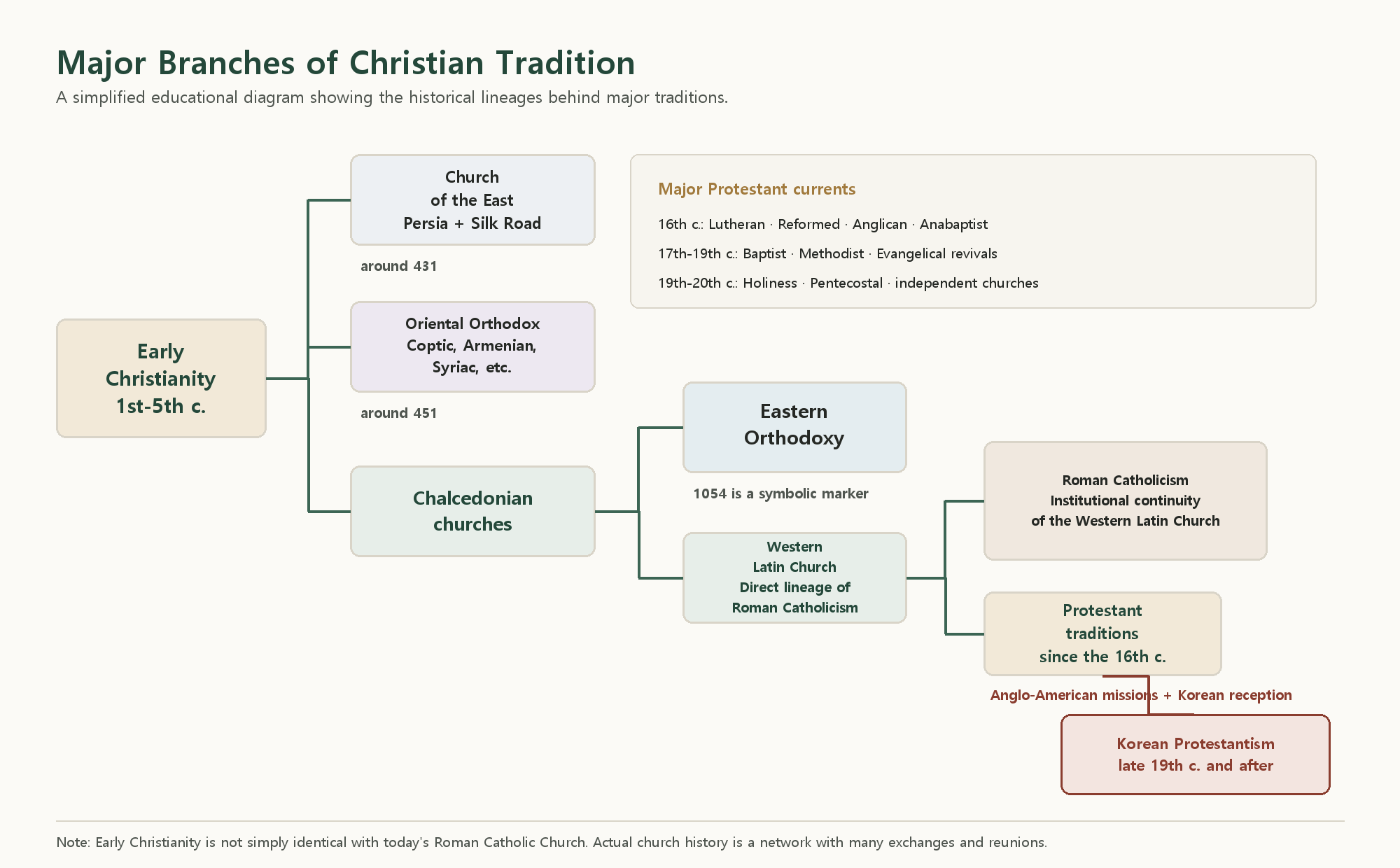
Major branches at a glance
| 1st-5th c. | Early Christianity | Communities across West Asia, North Africa, Europe, and Asia |
|---|---|---|
| c. 431 | Church of the East | Expansion through Persia and the Silk Road |
| c. 451 | Oriental Orthodox Churches | Coptic, Armenian, Syriac, Ethiopian, and related traditions |
| 1054 as symbol | Eastern Orthodoxy / Western Latin Church | A long East-West separation. The Western Latin Church is the direct institutional lineage of Roman Catholicism. |
| 16th c. | Roman Catholic reform / Protestant branching | The Western church was reorganized through the Reformation and Catholic reform. |
| 17th-19th c. | Lutheran, Reformed, Anglican, Baptist, Methodist, and other currents | Revival movements and global missions |
| Late 19th c. | Korean Protestantism | Korean reception + Scottish translation mission + American denominational missions |
The early church should not be equated simply with the modern Roman Catholic Church. Yet Roman Catholicism stands in institutional continuity with the Western Latin Church and did not suddenly originate in the sixteenth century.
Eight scenes that shaped two thousand years
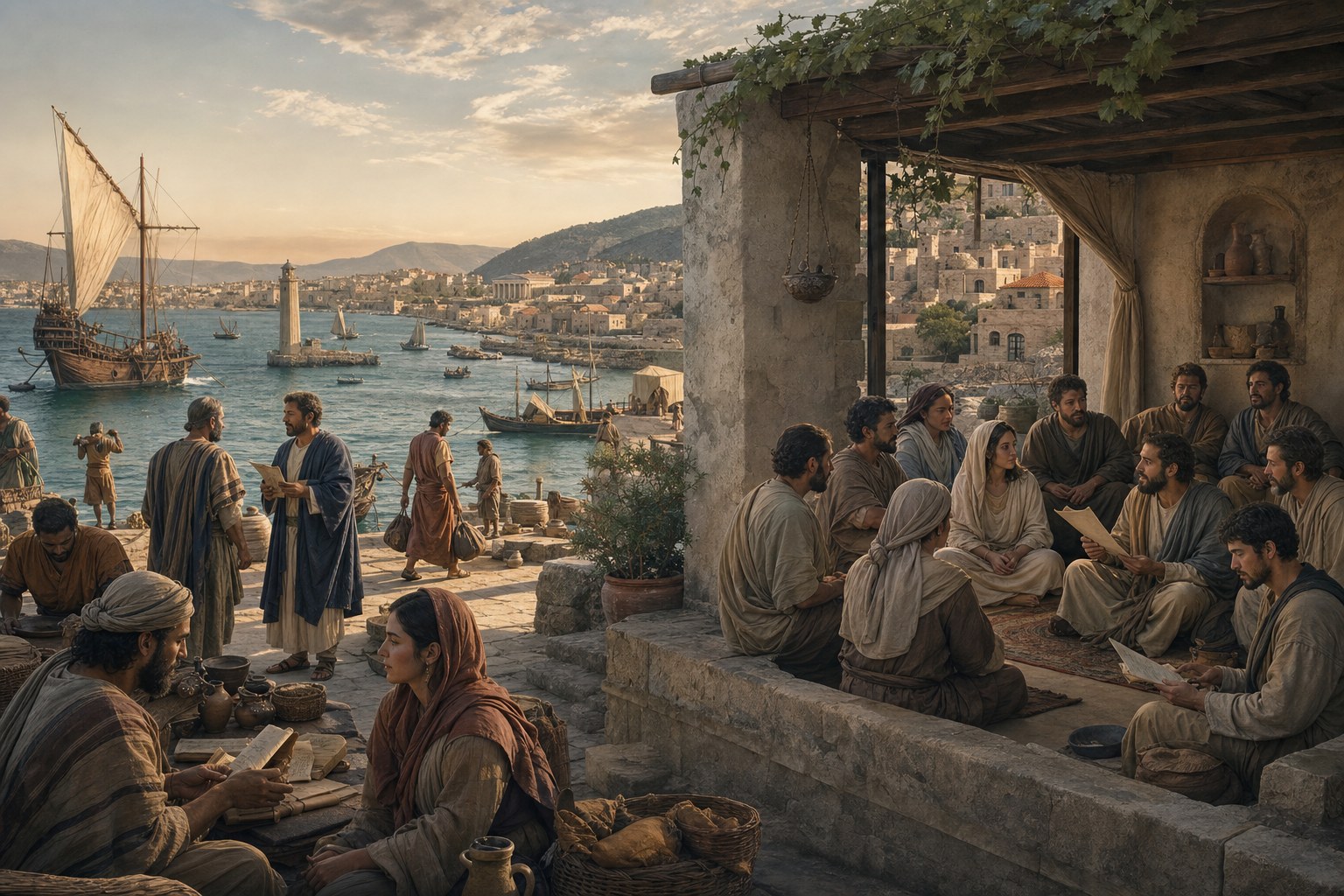
The movement also extended south toward Alexandria and east toward Edessa and Persia.
The Jesus movement within Judaism
Christianity did not begin as a European religion. It began in the Jewish world on the eastern edge of the Roman Empire and spread through Mediterranean cities.
- After the ministry and death of Jesus, communities of disciples formed around faith in the resurrection.
- Paul's letters were written around the middle of the first century, and the Gospels largely in the latter half of that century.
- Jerusalem, Antioch, Alexandria, and Rome were among several centers, and linguistic and cultural diversity was present from the beginning.
PointThe starting point was not Korea, America, or Europe, but the Jewish world of first-century West Asia.
Institutions and canon under pressure
A finished organization was not simply handed down at the start. Regional churches formed common language through debate, worship, and exchange.
- Offices such as bishops, presbyters, and deacons became more settled, and forms of worship and baptism developed.
- Long debates continued over which writings should be read as Scripture and how Jesus should be understood.
- Christianity spread early into Syria, Egypt, North Africa, Armenia, and Persia. Church history is not only Western European history.
PointEarly Christian unity was not produced by erasing diversity, but by forming agreement within diversity.
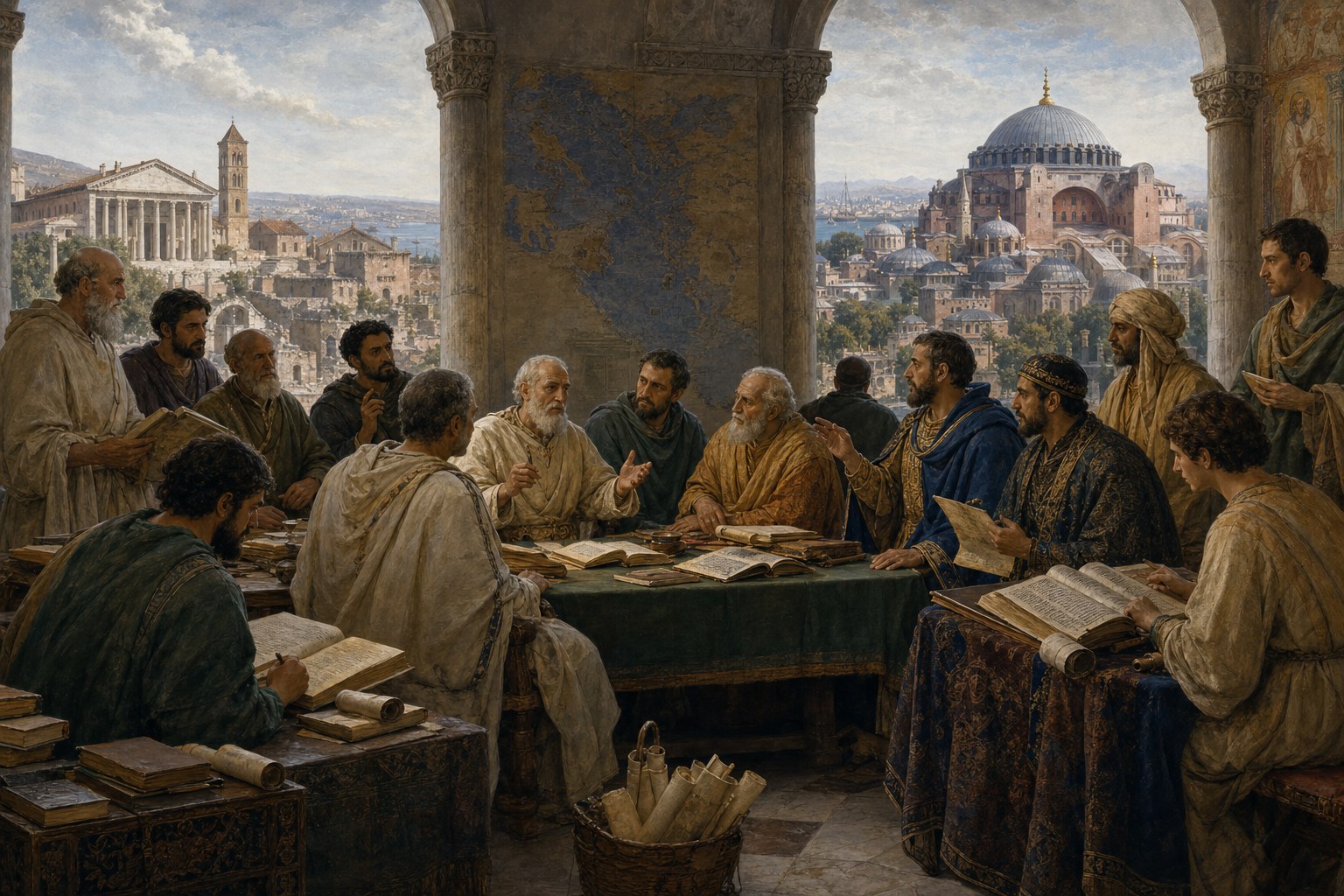
Latin-speaking Western churches, Greek-speaking Eastern churches, and Syriac, Coptic, and Armenian communities formed different historical worlds.
Imperial recognition, councils, and early branches
Christianity moved from a persecuted minority religion to a religion recognized and supported by imperial power. Doctrinal agreement strengthened, but new tensions with power also began.
- The Edict of Milan in 313 legalized Christianity, but Constantine did not create Christianity or immediately make it the state religion.
- The councils of Nicaea in 325 and Constantinople in 381 refined common language for the Trinity and the identity of Christ.
- Around the councils of Ephesus in 431 and Chalcedon in 451, the Church of the East and Oriental Orthodox traditions separated from the imperial church.
PointChristian traditions older than today's Catholic, Orthodox, and Protestant categories still exist.
More than one Christian world
Medieval Christianity does not simply mean the Western church centered on the bishop of Rome. Byzantine, Egyptian, Syriac, Persian, and Asian churches formed distinct historical worlds.
- The Western Latin Church developed around Rome, while the Eastern Greek church developed around Constantinople.
- 1054 is a symbolic date for East-West separation, but the actual division accumulated over centuries through language, politics, doctrine, and jurisdiction.
- The Church of the East reached Central Asia and China along the Silk Road. Asian Christian history is much older than modern Western mission.
PointThe equation “medieval church = Roman Catholicism” is too narrow to explain global church history.
Reformation and the reorganization of the West
Protestantism is not a separate religion that jumps directly from the early church. It is a family of movements formed in sixteenth-century reform disputes within the Western Latin tradition.
- Luther's controversy in 1517 began with indulgences and expanded into fundamental debates over Scripture, grace, and church authority.
- Lutheran, Reformed, Anglican, and Anabaptist movements followed different political and theological paths.
- Roman Catholicism also reformed institutions, education, and spirituality through the Council of Trent and related renewal. The era reorganized Western Christianity as a whole.
PointProtestantism is not synonymous with Christianity as a whole; it is one Western Christian branch about five centuries old.
Protestant diversification and global mission
European Protestantism moved into the Americas and divided into many traditions through Pietism, evangelical revivals, Methodism, Baptist movements, and other currents.
- Puritan, Baptist, Quaker, Methodist, and Presbyterian traditions developed different institutions and spiritualities in Britain and North America.
- Revival movements in the eighteenth and nineteenth centuries expanded personal conversion, Bible reading, voluntary societies, and overseas mission.
- Modern mission left education, medical work, and translation, while also requiring sober evaluation of its entanglement with imperial expansion.
PointWhat entered Korea was not a pure copy of the early church, but Christianity shaped by nineteenth-century Anglo-American evangelicalism and denominational structures.
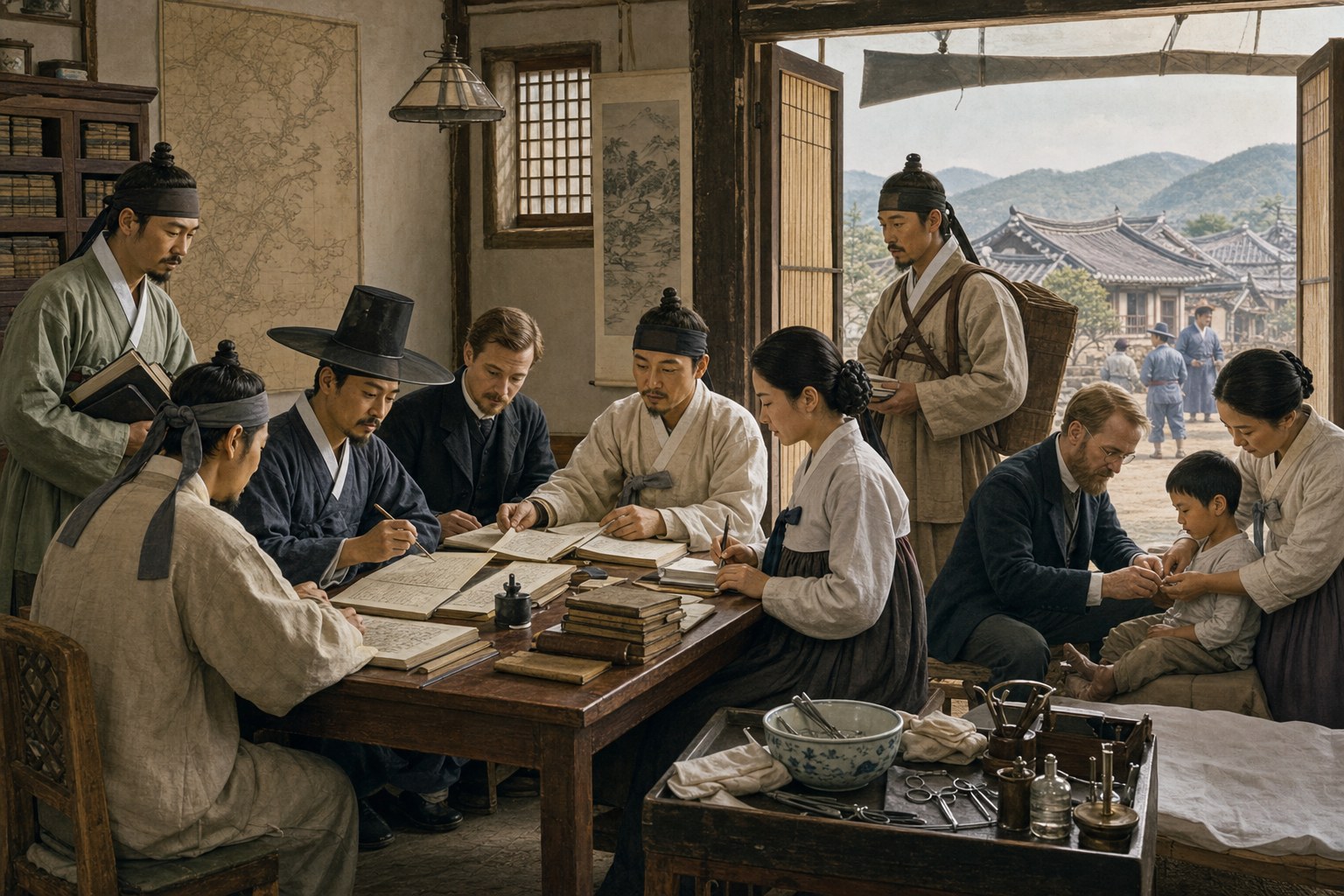
Scottish translation mission and Korean networks met American Presbyterian and Methodist missions through different routes on the Korean peninsula.
Two routes by which Christianity entered Korea
Korean Catholic and Protestant beginnings followed different paths. Catholicism grew from study and lay reception among Joseon intellectuals, while Protestantism grew through Korean translators and Scottish-American mission networks.
- A Korean lay Catholic community formed around Yi Seung-hun's baptism in 1784. It is an unusual case in which a believing community preceded resident foreign clergy.
- In Manchuria in the 1870s and 1880s, John Ross, John MacIntyre, and Korean translators produced Korean biblical texts. Luke and John appeared in 1882, and the New Testament in 1887.
- Horace Allen arrived in 1884, and Underwood and Appenzeller arrived in 1885. American Presbyterian and Methodist missions deeply shaped schools, hospitals, publishing, and church organization.
- Yet Korean Protestantism was not created by Americans alone. Early Korean believers, translators, colporteurs, teachers, and women evangelists were agents of expansion.
PointAmerican mission was decisive, but it was not the only beginning. Korean reception and translation were central.
Korean Protestantism amid empire, division, war, and growth
Korean Protestantism today cannot be explained by theology alone. Colonial experience, the Cold War, relations with the United States, industrialization, and urbanization all helped shape its character.
- Churches contributed to education, Hangul literacy, and independence movements, while also leaving failures such as late colonial accommodation to shrine worship.
- Division, the Korean War, northern Christian refugees, American aid, and anti-communism strongly influenced the growth of conservative evangelicalism.
- Industrialization saw the rise of megachurches, Pentecostalism, and revival movements, while urban industrial mission, Minjung theology, and democratization movements also developed.
- Korean Protestantism today carries both assets in education, welfare, and civic action, and problems such as clericalism, hereditary succession, political factionalization, and declining trust.
PointThe present form is not the inevitable conclusion of two thousand years of Christianity. It is one regional outcome formed within modern Korean history.
So where does Korean Protestantism stand?
To say that it is small and late is not to say that it is inferior. It means that no local experience has the right to identify itself with all of two thousand years of Christianity.
It belongs to a little over the final seven percent of roughly two thousand years of church history.
It was formed through the Western church, Protestantism, and Anglo-American evangelicalism.
A simple comparison across different survey years, still enough to show that Korean Protestantism is far below one percent of global Christianity.
How should the numbers be read?
Korea's roughly 9.68 million Protestants come from the 2015 Korean census, the latest published national census that included a religion item. The global figure of roughly 2.3 billion Christians and 28.8% of world population comes from Pew Research Center's 2025 report using 2020 estimates.
Because the survey years differ, the figures should not be treated as a precise denominational share. They do, however, show the scale clearly enough: Korean Protestantism is a very small part of global Christianity.
How should American influence be described?
American Presbyterian and Methodist missions were decisive in medicine, education, publishing, and denominational organization. After liberation, Cold War politics, American aid, study abroad, and seminary networks further strengthened American evangelical influence.
Yet early Korean biblical translation also involved Scottish missionaries and Korean translators, and the spread of communities depended on Korean lay believers, colporteurs, women, and teachers.
Korean Protestantism was formed through Korean reception joined to Scottish Bible translation and American denominational mission, and it took its present character amid twentieth-century Korean history and American influence.
Five common misunderstandings
Its origin is West Asian, and ancient traditions also developed in Egypt, Syria, Ethiopia, India, and Central Asia.
Christianity had already existed for about three centuries; Constantine legalized and supported it.
1054 is symbolic. The separation accumulated through centuries of cultural, political, and doctrinal tensions.
Protestantism is one family that emerged from the Western church in the sixteenth century, alongside Roman Catholic, Orthodox, and ancient Eastern traditions.
American influence was decisive, but Korean believers and translators, Scottish missions, and indigenous reception also mattered.
The distance history gives
Korean Protestantism is not the center, completion, or only standard of Christian history. It is one form produced when a movement that began in Jerusalem passed through languages, empires, councils, divisions, reforms, and missions before arriving on the Korean peninsula and being shaped within modern Korean history.
This does not erase the meaning of Korean churches. It gives them proportion. When a church sees itself within a larger tradition, it can learn from unfamiliar traditions and correct its own errors. Age alone does not make something right, and growth alone does not make something universal.
References and data
For an introductory overview, this guide cross-checks representative scholarship and public statistics. Dates of division are used only as markers for longer historical processes.
- Diarmaid MacCulloch, Christianity: The First Three Thousand Years (Viking, 2009).
- Justo L. Gonzalez, The Story of Christianity, Vols. 1-2, rev. ed. (HarperOne, 2010).
- Henry Chadwick, The Early Church, rev. ed. (Penguin, 1993).
- Sebastian C. H. Kim and Kirsteen Kim, A History of Korean Christianity (Cambridge University Press, 2015).
- Sung-Deuk Oak, The Making of Korean Christianity: Protestant Encounters with Korean Religions, 1876-1915 (Baylor University Press, 2013).
- James Huntley Grayson, Korea: A Religious History, rev. ed. (RoutledgeCurzon, 2002).
- Pew Research Center, How the Global Religious Landscape Changed From 2010 to 2020 (2025). Estimate for 2020: about 2.3 billion Christians, 28.8% of world population.
- Statistics Korea, 2015 Population and Housing Census sample results: religious population (2016). As of June 2026, this is the latest published national census with a religion item.
- Academy of Korean Studies, Encyclopedia of Korean Culture entries related to Protestantism, Catholicism, and Bible translation.
- Encyclopaedia Britannica entries on Christianity, the Council of Nicaea, the East-West Schism, and the Reformation.